
From Bandhani to Beverly Hills, Anita Dongre is rewiring India’s craft supply chain
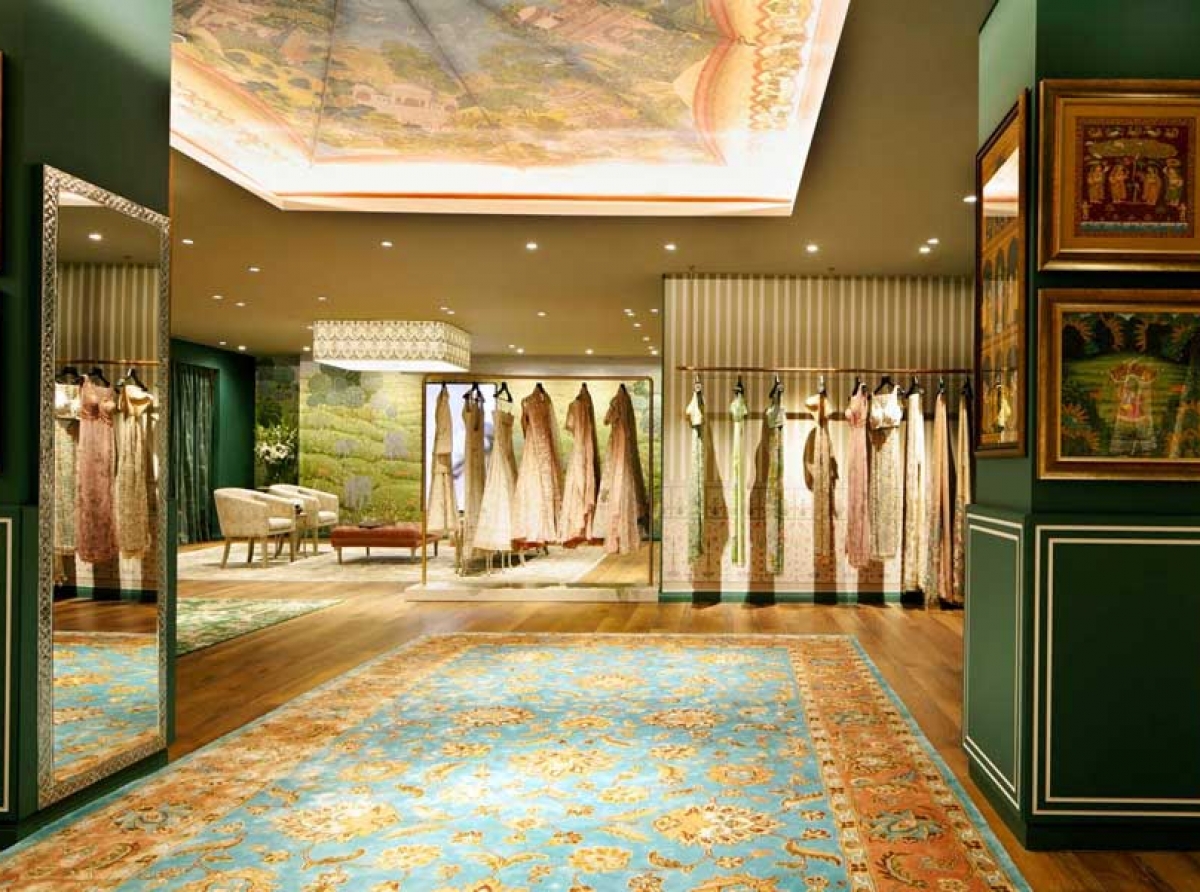
3 April 2026, Mumbai
A 500-year-old Bandhani tie-dye technique from Rajasthan is undergoing a repositioning from a regional craft to a codified design language on global luxury. And taking this initiative is designer and entrepreneur Anita Dongre through her J.Lo Supply initiative. This signals a decisive break from the legacy ethnic wear silo. Bandhani is no longer being marketed as heritage ornamentation; it is being engineered as a contemporary, high-performance textile aligned with global luxury expectations.
The timing is strategic as the global luxury market, valued at $352.8 billion in 2025, is projected to reach $562.1 billion by 2034, creating a widening demand pool for differentiated, provenance-rich materials. Where European houses such as Hermès and Burberry built enduring brand equity around equestrian and trench-coat archetypes, Dongre’s approach effectively industrializes India’s artisanal ecosystems. The ambition is not aesthetic revivalism but supply chain reinvention, transforming decentralized craft clusters into scalable, quality-assured production systems capable of servicing global maisons. This reframing positions India’s artisan economy not as a cultural adjunct but as a competitive manufacturing backbone within the global luxury value chain.
Export momentum and the rise of traceable craft
The commercial validation of this shift is visible in India’s handicraft export data, which is increasingly decoupling from diaspora-driven consumption and aligning with mainstream global demand.
Table: Comparative growth in Indian craft export categories (April-Feb 2024-25 vs 2023-24)
|
Category |
Export ($ mn) |
YoY growth ($) |
|
Handprinted Textiles & Scarves |
$293.30 |
+42.95% |
|
Zari & Zari Goods |
$6.20 |
+17.88% |
|
Embroidered & Crocheted Goods |
$488.32 |
+10.83% |
|
Woodwares |
$868.15 |
+4.56% |
Source: DGCI&S and EPCH Provisional Data
The table reveals a clear hierarchy of growth drivers within the handicrafts ecosystem. Handprinted textiles and scarves have emerged as the breakout category, registering a 42.95 per cent year-on-year increase. This is not incidental; it reflects a shift in global sourcing strategies. Techniques such as Bandhani and Ajrakh are being recontextualized for international markets that increasingly prefer authenticity, traceability, and low-impact production processes.
The comparatively moderate growth in woodwares suggests that categories with lower design intervention or weaker storytelling frameworks are not benefiting equally from this demand shift. Meanwhile, embroidered and crocheted goods, with double-digit growth, indicate steady but less explosive traction, likely constrained by longer production cycles and higher labor intensity.
Geographically, the US, accounting for nearly 38.69 per cent of total exports remains the biggest market, followed by the UK. These markets are not merely absorbing volume; they are actively shaping product evolution through a preference for artisanal provenance over synthetic uniformity. What emerges is a renaissance of the natural, where handcrafted textiles are no longer niche but central to premium apparel strategies.
The supply chain imperative
Despite strong demand tailwinds, the Indian artisan economy remains fragmented. With over 6.4 million artisans, approximately 64 per cent of whom are women the sector represents one of the largest decentralized workforces globally. However, this scale is undermined by inconsistencies in quality, lead times, and process standardization.
The intervention model pioneered by Dongre’s J.Lo Supply addresses this gap through the creation of design-led aggregation hubs. These hubs function as translation layers between artisanal production and global retail requirements. They codify traditional techniques into standardized specifications, ensuring repeatability without diluting craftsmanship.
This approach aligns with a broader shift in luxury consumption. Approximately 35 per cent of global luxury consumers now prioritize ethical production and supply chain transparency. Initiatives such as Pehchan, which has registered over 3.2 million artisans, are further enabling traceability by formalizing artisan identities within the value chain.
The net effect is a transition from invisibility to authorship. Indian artisans are no longer anonymous contributors embedded deep within supply chains; they are increasingly being recognized as creative collaborators for global fashion houses, including Dior and Valentino. This shift carries both economic and reputational upside, elevating India’s position from a sourcing destination to a co-creation partner.
Rationalizing scale at the House of Anita Dongre
The financial growth path of the House of Anita Dongre (HOAD) gives a clear understanding of the economics of this change. In FY2025, HOAD reported a 21 per cent revenue decline to reach Rs 347 crore). At first glance, this derop appears counterintuitive in a high-growth market. However, the decline was the result of a deliberate portfolio rationalization strategy, involving the closure of 171 underperforming stores across Tier-II and Tier-III cities.
This retrenchment was accompanied by a shift toward premiumization. By concentrating resources on high-margin international flagships, particularly in New York and Beverly Hills, the latter launched in June 2025 the company improved its operating profit margins despite lower topline revenue. This underscores a critical principle for India’s craft-led luxury ambitions: scale, in a global context, is not defined by retail footprint but by value density. High-yield international nodes, supported by a strong artisanal backend and higher profits compared to a dispersed domestic mass-market presence. In effect, HOAD’s strategy mirrors that of established global luxury players prioritizing brand equity, pricing power, and controlled distribution over volume-driven expansion.
Since its opening in 1995, the House of Anita Dongre has evolved from a domestic boutique operation into a multi-brand enterprise spanning labels such as AND, Global Desi, and the artisan-centric Grassroot. This portfolio reflects a calibrated segmentation strategy, balancing accessible fashion with high-end, craft-led luxury.
While the group has negotiated various pressures in recent years, its reorientation toward international luxury markets and artisanal differentiation has strengthened operating margins. More importantly, it has established a replicable blueprint for integrating traditional craftsmanship into a modern, globally competitive business model. What emerges is a new archetype for Indian fashion, a shilp griha or House of Craftsmanship, that is as much about supply chain engineering as it is about design.
Therefore, India’s artisan economy is entering a phase of institutional maturity. Global demand for traceable luxury, domestic efforts at supply chain formalization, and entrepreneurial leadership is boosting craft from a cultural asset into a strategic commercial infrastructure. The Bandhani shift is emblematic of this broader shift. It demonstrates that the future of Indian textiles lies not in preserving tradition as static heritage, but in reengineering it as a scalable, high-value input for the global luxury industry.
In this new paradigm, India is no longer merely exporting products; it is exporting process, provenance, and a distinctly differentiated model of value creation one that could redefine the contours of global fashion supply chains over the coming decade.










 Get in Touch!
