
India’s ethnicwear brands shift from festive stocking to fast drops
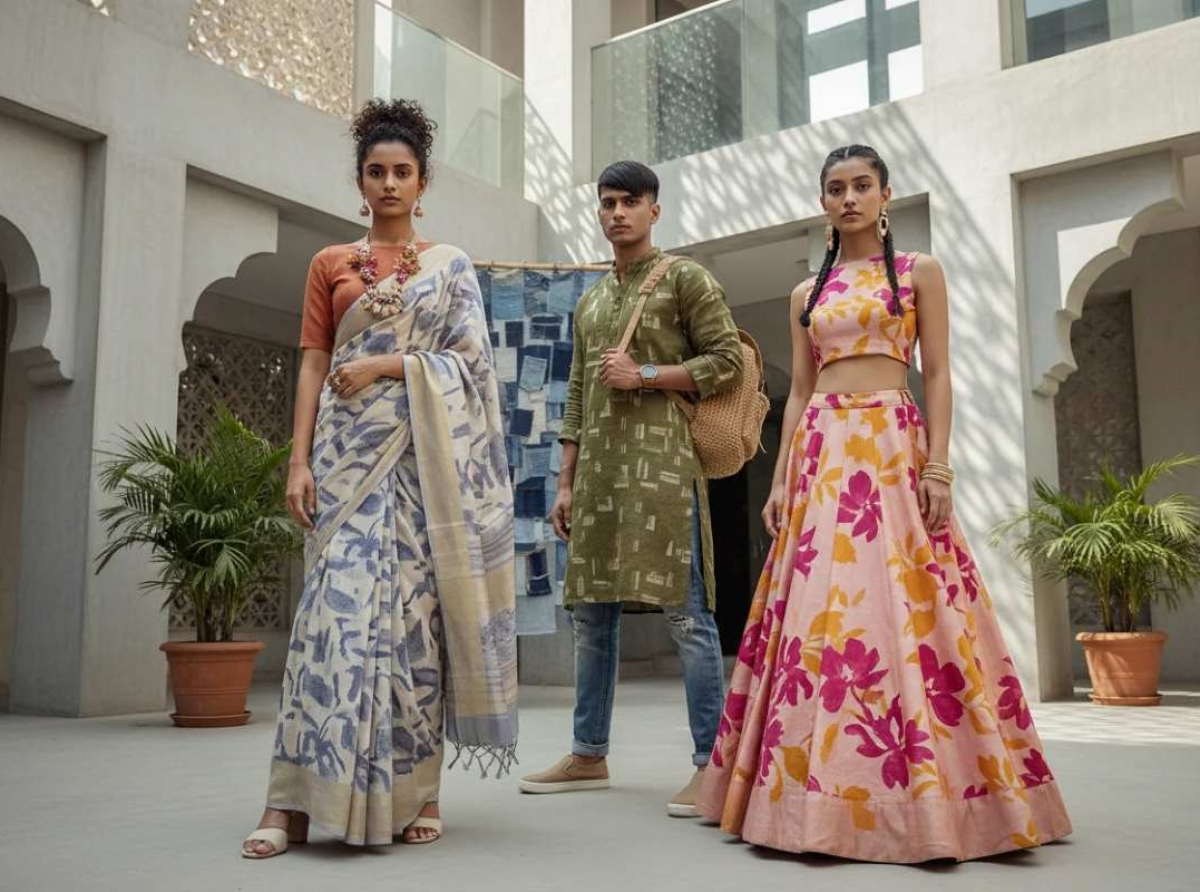
India’s 2026 festive retail cycle is being reshaped by a younger consumer who is buying ethnicwear more frequently, for more occasions and at more accessible price points. Gen Z is no longer a low-Average-Order-Value (AOV) customer at the margins of fashion retail. As the oldest members of the cohort approach 30, their growing purchasing power is making them a core growth engine for ethnicwear.
Industry estimates from Vyansi Intelligence put India’s ethnic apparel market at $22.8 billion in 2026, with women’s wear accounting for about 70 per cent. The larger opportunity, however, lies in trend-first fashion. Bain & Company expects India’s trend-first fashion market to quadruple to $8-10 billion by 2028, with online channels contributing more than half of sales. The shift is also moving offline. JLL data shows retail leasing across leading Indian cities rose 10.5 per cent in H1 2026 to 6.27 million sq ft. Fashion accounted for 48 per cent of the space, while direct-to-consumer brands took 27 per cent.
Table: India retail 2026 overview, benchmarks & growth drivers
|
Retail Detail |
Benchmark 2026 |
What it means |
|
Ethnicwear market |
$22.8 billion |
Large base across festive and everyday demand |
|
Trend-first fashion by 2028 |
$8-10 billion |
Fast-cycle brands gain share |
|
Gen Z share of fashion spending |
47% |
Young consumers become a primary growth driver |
|
Core price band |
Rs 899-2,499 |
Supports frequent micro-occasion purchases |
|
Target inventory turn |
21-30 days |
Reduces markdown and working-capital pressure |
|
H1 retail leasing |
6.27 mn sq. ft. |
D2C and fashion brands accelerate physical expansion |
Supply is no longer the advantage
For years, access to manufacturing clusters was considered a competitive advantage in Indian ethnicwear. That equation is changing rapidly. Digital sourcing networks now allow emerging labels to connect with production centres in Surat, Jaipur and Lucknow and access similar chikankari bases, dabu prints, embroideries and other techniques. The result is a democratisation of manufacturing. A brand does not necessarily gain a lasting advantage simply because it can source a particular fabric or technique.
The more important question is how quickly that product can be converted into sales. For new-age ethnicwear businesses, the operating model resembles more like fast fashion: smaller production batches, frequent catalogue refreshes and rapid replenishment based on actual demand. Instead of committing heavily to an entire festive season months in advance, brands can test micro-collections and scale winners while limiting exposure to slow-moving inventory.
This makes inventory rotation a more important commercial need than manufacturing access. A 21-30-day inventory cycle can significantly reduce markdown dependence compared with traditional models that may hold stock for 90 days or more.
Festive demand becomes a daily opportunity
The biggest change is not simply who is buying ethnicwear but why they are buying it. Millennial consumers have traditionally associated ethnicwear with weddings, major festivals and family celebrations. Gen Z is widening the occasion universe. College events, office celebrations, regional festivals, pre-wedding functions, social gatherings and casual festive occasions are creating more frequent purchase opportunities. This micro-occasion economy favours affordable fashion. The Rs 899-2,499 price band allows consumers to build multiple looks rather than make an occasional high-ticket purchase.
It also changes how brands design collections. Instead of treating Diwali, Navratri or Durga Puja as isolated seasonal peaks, brands can create culturally specific drops throughout the year. Onam-inspired collections, Bollywood nostalgia, Y2K styling and indie-handloom influences can each become short-duration commercial stories. The strategy is therefore shifting from selling one festive outfit to capturing a consumer’s entire calendar of occasions.
Culture becomes the new reason
If manufacturing is becoming commoditised, cultural relevance is emerging as a more defensible advantage. Digital-native brands can use social media to identify emerging aesthetics, regional preferences and celebrity-led trends, then translate those signals into products within weeks. The ability to connect fashion with cultural moments creates differentiation that cannot be replicated simply by accessing the same supplier.
This is particularly important in ethnicwear, where purchase decisions are influenced not only by design and price but also by identity, region and occasion. Legacy retailers are responding by creating younger, more agile propositions. BIBA NXT and Libas’s Gerua, for instance, represent the broader strategy of separating trend-led offerings from traditional core lines. Such sub-brands allow established companies to experiment with faster product cycles without completely repositioning their parent brands.
Stores become test labs
The rise of physical retail does not contradict the digital-first nature of Gen Z fashion. Instead, stores are now becoming extensions of the online discovery journey. The 6.27 million sq ft of retail leasing recorded in H1 2026 indicates that fashion and D2C brands are using physical outlets to increase visibility, enable trial and build stronger consumer relationships. For ethnicwear, this is particularly relevant because fit, fabric, colour and detailing remain important purchase considerations. The winning model is therefore likely to be hybrid: digital channels identify trends and drive discovery, while stores provide experience, trial and faster fulfilment.
The Libas model
Ethnic brand Libas highlights the commercial opportunity in this transition. Founded in 2013, the omnichannel Indianwear brand has built its proposition around fast-turned women’s ethnic apparel across its own stores, department stores and major e-commerce platforms. The strategy reflects a broader market direction: expand SKUs, develop sub-brands, increase high-street presence and target younger consumers without abandoning the scale of the core ethnicwear business. The company is targeting annual revenue of Rs 1,000 crore.
For the wider industry, the lesson is clear. The next phase of ethnicwear competition will not be won merely by owning better suppliers or more manufacturing capacity. It will be determined by how quickly a brand can identify a cultural signal, turn it into a product, place it in front of consumers and clear inventory before the trend fades. India’s festive market is becoming less about stocking for a season and more about rotating through a culture. The brands that master that cycle could build the strongest retail moats.







 Get in Touch!
