
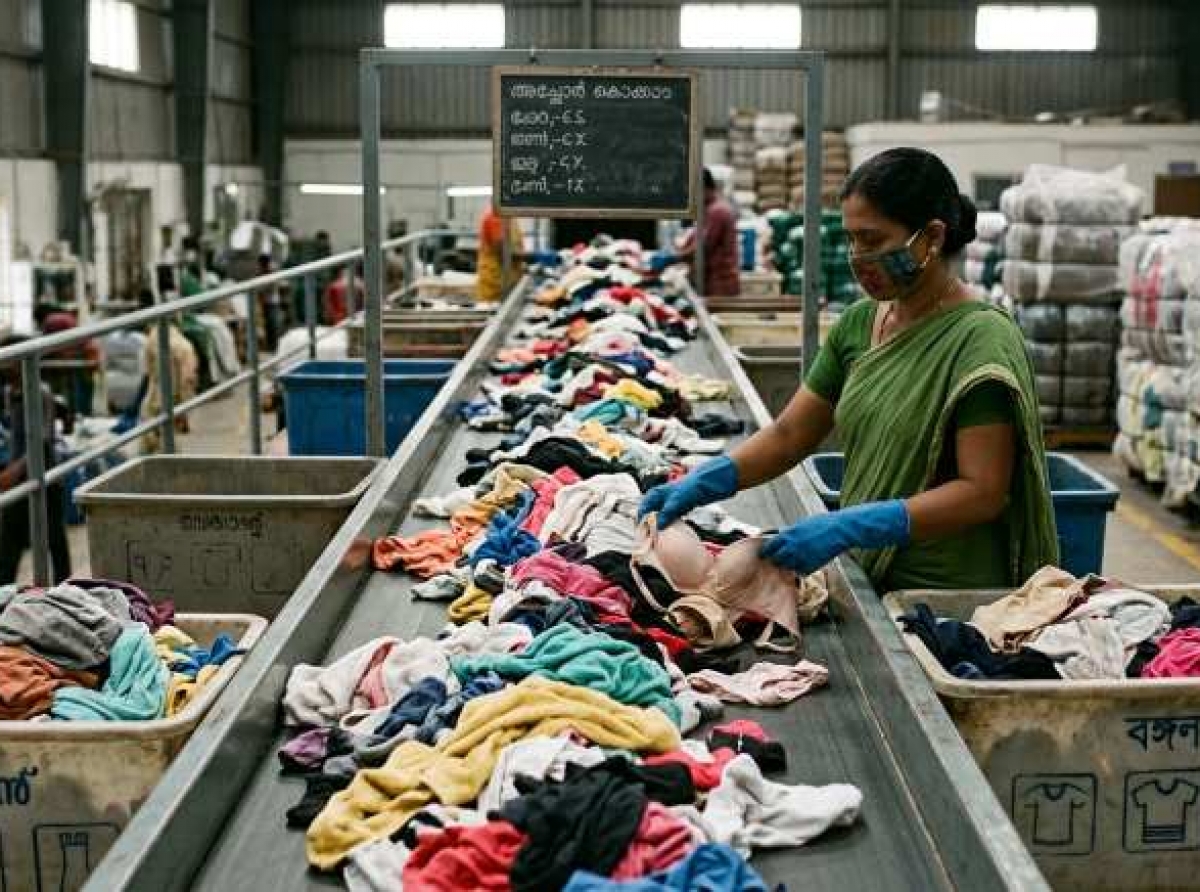
India’s intimate-wear market is entering a new phase of sustainability, one that shifts the conversation from how responsibly a garment is made to what happens when it reaches the end of its useful life. Direct-to-consumer intimate apparel brand Mahina’s post-consumer take-back programme for period underwear, in partnership with textile recovery aggregators Respun and Tooused, offers an early template for addressing this gap. The initiative creates a recovery channel for technical intimate garments that would otherwise enter mixed municipal waste streams.
The significance extends beyond menstrual wear. As apparel brands sell performance, durability and sustainability together, the absence of credible end-of-life systems is becoming a structural weakness in the circularity proposition.
Closing the last mile
Reusable period underwear shows the complexity of textile recovery. Unlike conventional cotton garments, these products combine several functional layers: moisture-wicking cotton, absorbent fleece, waterproof membranes and stretch polymers. Such construction enables the garments to withstand as many as 100 wash cycles, but makes them difficult to recycle through conventional textile systems.
Once returned, Mahina’s recovery chain involves sanitisation, manual seam extraction and component sorting. Cotton-rich sections can enter mechanical garnetting, while elastomeric and polyurethane-heavy components can be diverted into applications such as insulation, carpet underlay and automotive acoustic padding.
Table: Layer-by-layer material & recycling breakdown
|
Material layer |
Technical composition |
Primary function |
End-of-life stream |
|
Inner top sheet |
95% organic cotton, 5% spandex |
Moisture wicking and comfort |
Mechanical garnetting / downcycled yarn |
|
Absorbent core |
Bamboo terry / polyester micro-fleece |
Liquid capture |
Shredded fibre recovery / mattress batting |
|
Barrier membrane |
TPU + polyester |
Leak protection |
Thermal insulation / downcycling |
|
Structural shell |
Polyamide-elastane knit |
Fit and compression |
Industrial acoustic backing |
Economics before ecology
The biggest challenge is not consumer awareness alone. It is reverse-logistics economics. A six-month pilot across Bengaluru, Mumbai and NCR involving 14,000 active users found that only 28 per cent of eligible consumers enrolled in the return stream after reaching the product’s approximately 24-month lifespan. Doorstep collection cost Rs 85-110 per shipment, while consolidated residential drop-offs brought the cost down to about Rs 32 per unit. The recovered material itself generated only Rs 18-22 per kg in secondary-market value. Recycling therefore remains a cost centre rather than a profitable standalone business.
For D2C brands, the commercial justification lies elsewhere, in customer retention, repeat purchases and lower customer acquisition costs. Return incentives can turn an otherwise expensive reverse-logistics operation into a loyalty mechanism.
Technology is the bottleneck
India’s existing textile-recycling infrastructure is better suited to mono-material waste than technical garments. Recycling clusters like Panipat, Tirupur have developed around relatively straightforward cotton, polyester and textile-waste streams. Multi-layer intimate apparel is fundamentally different. Elastane, cotton, polyester and waterproof membranes can be bonded or tightly integrated, making fibre separation difficult without damaging fibre quality.
Chemical depolymerisation and enzymatic delamination technologies could eventually change the economics, but commercial availability remains limited.Until these technologies become scalable and affordable, processors are likely to depend on labour-intensive dismantling and mechanical downcycling. That makes design-for-recycling important. Brands that engineer garments for easier separation at the design stage could reduce the cost of recovery several years later.
The landfill question
The case for intervention is strengthened by the sheer volume of menstrual waste. Estimates cited by the sector put India’s annual menstrual waste generation at roughly 113,000 tonnes, with billions of single-use sanitary products entering waste systems every year. Reusable products reduce the number of disposable products consumed, but their environmental proposition ultimately depends on what happens after their useful life.
This creates an uncomfortable paradox for sustainable apparel: a product can reduce consumption during its active life while still creating a difficult waste stream at the end of it.
Retail’s next test
The implications extend beyond period underwear to innerwear, shapewear, swimwear and activewear, where blended fibres, elastane and technical finishes are increasingly common. India’s large intimate-wear companies including Page Industries, Lux Industries and Rupa & Co. operate at a vastly different scale from emerging circular brands. Their eventual challenge will be designing collection systems that work across millions of low-ticket garments without making reverse logistics economically prohibitive.
This is where the circularity debate moves from brand storytelling to operating architecture. Collection points, retailer incentives, consolidated transport, material sorting and secondary markets will determine whether textile take-back systems can scale.
From claims to accountability
Mahina’s experiment does not yet establish that post-consumer recycling of intimate apparel is commercially self-sustaining. Instead, it highlights the operational question the category must confront: Who collects the garment? Who sanitises it? Who dismantles it? Who pays for transportation? And, critically, who buys the recovered material?
Those questions will become more and more relevant as sustainability regulation and corporate accountability expand across the apparel value chain. For India’s intimate-wear industry, the next competitive frontier may therefore not be another fabric innovation. It could be the ability to show a credible journey for the garment after the consumer has finished wearing it. The winners of circular retail will ultimately be those capable of connecting the first sale to the final material recovery.











 Get in Touch!

