
Brocade Diplomacy: How ‘Indian Handlooms’ captured the global luxury narrative
28 January 2026, Mumbai
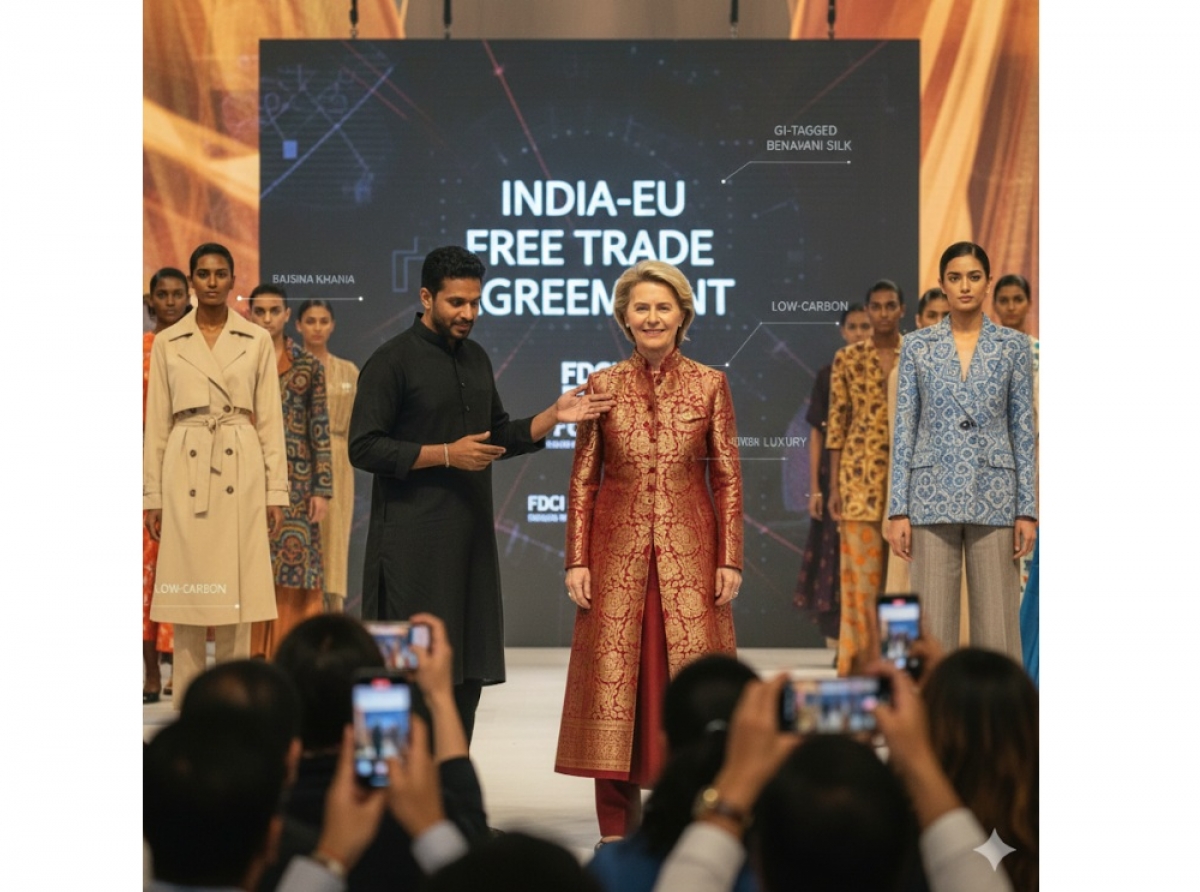
The 77th Republic Day parade at Kartavya Path transcended its traditional role as a display of national heritage, evolving into a high-stakes showcase for India’s premium textile sector. European Commission President Ursula von der Leyen, usually defined by her rigid European "power suits," made a significant aesthetic shift that has sent ripples through the global fashion industry. Her choice of a maroon and gold Benarasi silk brocade bandhgala jacket was not merely a cultural nod; it was a strategic validation of Indian handlooms on a global stage where "quiet luxury" and "provenance" are the new market currencies.
Structured Heritage: The rise of Indo-European Fusion
The ensemble, a collaboration between the Fashion Design Council of India (FDCI) and designer Rajesh Pratap Singh, highlighted a growing commercial trend: the integration of centuries-old artisanal techniques with contemporary, structured silhouettes. Singh, known for his architectural precision, utilized a hand-loomed GI-tagged Benarasi silk, proving that traditional textiles are ready for high-fashion scrutiny. Industry experts suggest this "fusion" category is one of the fastest-growing segments in the $15 billion Indian luxury market, projected to grow at a CAGR of 10% through 2026. This aesthetic transition signals to global buyers that Indian crafts can be decoupled from purely "ethnic" contexts and marketed as versatile luxury staples.
Scaling the Artisanal: From Varanasi to Milan
The visibility of this Benarasi jacket coincides with a major shift in how the global North views Indian craftsmanship. Traditionally the "back-office" for European luxury houses, Indian designers are now reclaiming the narrative. With the global handloom market expected to surge to $16.62 billion by 2032, the spotlight on the Benaras cluster—which supports over 100,000 active weavers, is crucial. Retailers in Paris and Milan are increasingly looking for "meaningful consumption" triggers, where the story of the maker is as valuable as the thread itself. The use of metallic zari and silk-satin weaves in the President’s attire serves as a masterclass in how to present heritage as a globally relevant, premium product.
The sustainability edge in premium retail
As the fashion industry faces stringent new traceability and ESG (Environmental, Social, and Governance) norms, handlooms offer a unique competitive advantage. Unlike mass-produced synthetics, hand-woven silk is a low-carbon, biodegradable alternative that aligns with the "slow fashion" movement. For European retailers, Indian handloom clusters represent a "ready-to-wear" solution for ethical sourcing. Designers like Abraham & Thakore and Anamika Khanna, who also dressed the EU chief during her visit in Bandhani and Resham embroidery respectively, are at the forefront of this shift, turning decentralized artisanal hubs into highly responsive, sustainable supply chains for the international elite.
The Benaras transformation
Once relegated to traditional bridal wear, the Varanasi (Benaras) silk cluster has undergone a commercial revolution. By standardizing quality through Geographical Indication (GI) tags and collaborating with contemporary designers like Rajesh Pratap Singh, the cluster has moved into the "prestige prêt" category. This transition allows weavers to command higher price points in international markets, shifting from commodity-based pricing to value-based luxury.
The Indian premium handloom landscape
The Indian handloom sector is the second-largest employer in the rural economy after agriculture, involving over 4.5 million artisans. Specializing in high-value categories like Benarasi, Kanchipuram, and Muga silk, the industry is a cornerstone of India’s $44 billion textile export engine. Current growth plans focus on "Farm-to-Fashion" integration through Mega Textile Parks, aiming to double handloom exports by 2030 through digital traceability and global designer collaborations.





 Get in Touch!
