
India's retail real estate shakeout creates space for digital-native brands
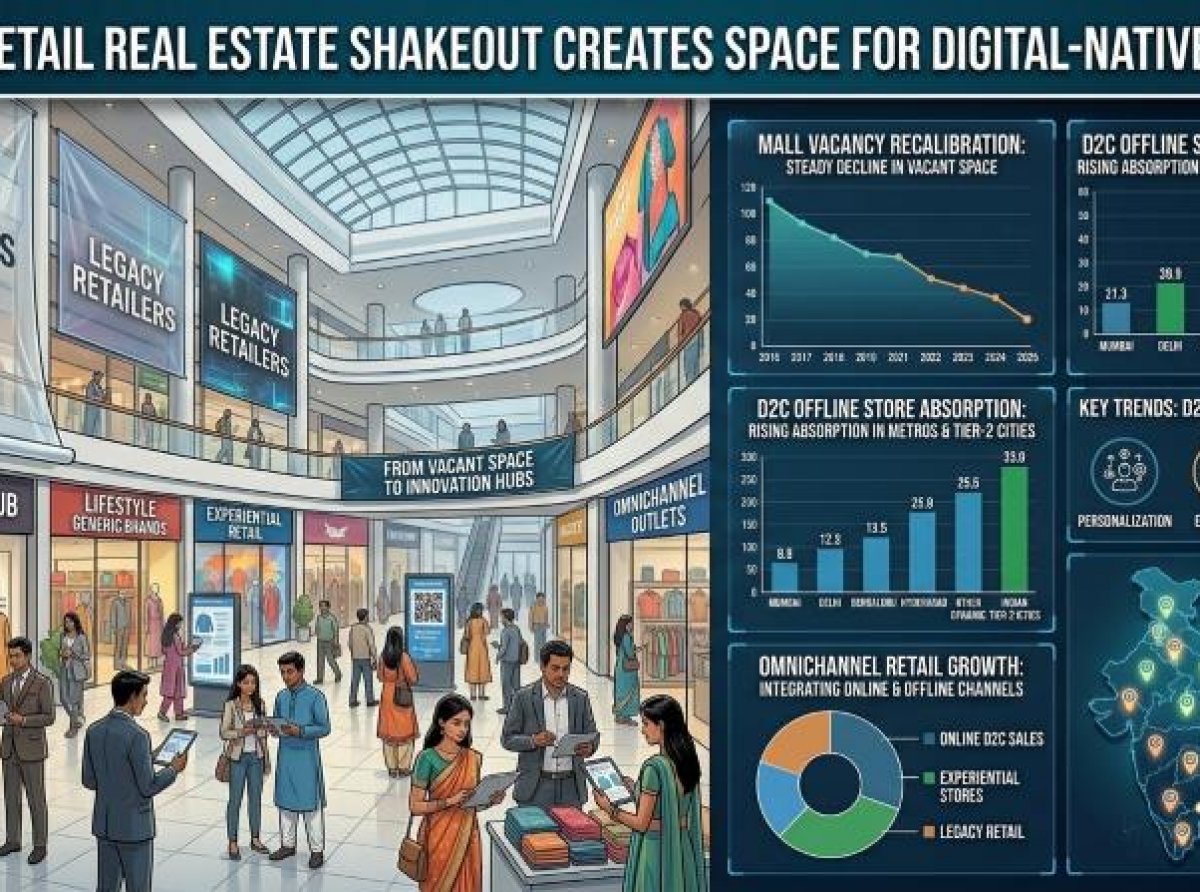
India’s retail real estate market has seen a shift in tenant composition. As traditional mid-market apparel chains rationalise store networks, digitally native fashion and lifestyle brands are moving into prime shopping centres across metros and Tier-II markets. The shift signals a new phase in retail growth, with online-first businesses using physical stores to strengthen consumer engagement, improve margins and build omnichannel distribution.
The transition is also changing the leasing priorities of institutional mall developers. Rather than relying exclusively on established apparel chains and conventional departmental stores, landlords are now looking at digital-first brands with strong online communities, younger customer bases and the ability to generate repeat footfall.
Data from real estate consultancy CBRE shows, digitally native brands have increased their share of India's total retail leasing activity from 8 per cent to nearly 18 per cent. Their growing presence across DLF CyberHub and Pacific Malls in Delhi-NCR, Phoenix Mills properties in Mumbai, Bengaluru and Pune, and Lulu Malls in South India reflects the expanding role of omnichannel retailers in commercial real estate.
Changing retail tenant
The growth comes as India's traditional mid-tier apparel network undergoes consolidation. While large retail operators such as Trent, through Zudio and Westside, and Reliance Retail continue to expand through scale, sourcing efficiencies and extensive distribution networks, several legacy apparel chains and regional departmental brands are rationalising their store portfolios. Margin pressure, high operating costs, slower inventory cycles and changing consumer preferences have exposed weaknesses in conventional retail models.
Digital-first brands are approaching the same market differently. Instead of building large nationwide networks immediately, they are prioritising flagship outlets, experience centres and high-density locations that can support both physical and online sales. For mall developers, this is an opportunity to replace declining or underperforming tenants with brands that bring digitally engaged consumers into physical retail environments.
Two different retail models
The distinction between traditional apparel chains and digital-native omnichannel operators is visible in their inventory management, store economics and marketing strategies.
Table: A comparison of two model
|
Operating model |
Legacy apparel chains |
Digital-native omnichannel brands |
|
Retail strategy |
Extensive nationwide networks with high fixed inventory |
Selective flagship stores and experience-led outlets |
|
Inventory cycle |
6-9-month seasonal collections |
2-3 week test-and-repeat production cycles |
|
Store function |
Primarily sales and distribution |
Customer acquisition, product trials and brand building |
|
Marketing |
Print, mall advertising and seasonal promotions |
Social media, creator partnerships and digital campaigns |
|
Fulfilment |
Disconnected warehouses and standalone billing |
Integrated POS/ERP, BOPIS and local returns |
The difference is particularly evident in inventory decisions. Traditional retailers typically commit to seasonal merchandise well in advance, leaving them exposed to discounting when demand forecasts miss the mark. Digital-native brands use website searches, customer feedback and online sales patterns to identify emerging demand. Smaller production batches allow them to test products, replenish successful styles and limit exposure to unsold inventory. Their physical stores extend this model by giving consumers opportunities to examine fabrics, assess fits and experience products before purchasing.
Reasons for store expansion
The move offline is a response to deteriorating online acquisition economics. Customer acquisition costs across major digital advertising networks have reportedly increased by 30-40 per cent for India's direct-to-consumer businesses. At the same time, online fashion return rates frequently range between 25 per cent and 35 per cent, with sizing issues, delivery refusals and cash-on-delivery cancellations adding to reverse logistics expenses.
For brands operating on relatively thin margins, these costs can undermine the economics of pure-play e-commerce. Physical stores offer an alternative. Customers can assess garments before purchasing, reducing the likelihood of fit-related returns. The information provided indicates that this can lower reverse logistics costs by up to 15 per cent.
Assisted selling also creates opportunities to increase transaction values. In-store styling, product recommendations and fitting assistance can lift average order values by 15-20 per cent compared to online transactions.
The benefits extend beyond direct store revenue. Physical outlets can generate a local digital demand multiplier, commonly described as the pin-code halo effect. According to industry estimates, opening an exclusive brand outlet can increase digital orders by 20-35 per cent among consumers living within a 3-5 km radius. The store effectively becomes a local discovery and trust-building centre, strengthening online conversion in its catchment.
A global retail realignment
India's transition reflects a broader international pattern in which digital-first brands are occupying retail spaces vacated by traditional chains. In the US, the decline of heritage department store networks has created opportunities for online-originated businesses such as Warby Parker, Vuori and Skims. These brands are using physical locations to reduce dependence on performance marketing and build stronger consumer relationships.
In the UK and Western Europe the collapse and restructuring of established retail groups, including Arcadia, created opportunities for digitally native operators. Gymshark and Castore have increased their physical presence through flagship stores and high-street locations, using community engagement and brand experiences to complement online distribution.
A similar trend is visible in Australia, where online-led labels such as Princess Polly and VRG GRL are entering shopping centres and taking advantage of spaces vacated by struggling regional chains. Across these markets, physical retail is being repositioned. Stores are no longer simply distribution points; they are becoming brand-building and customer-retention assets.
The cost of going offline
Despite the opportunity, expanding into physical retail brings substantial operational challenges for digital-first businesses. Commercial rental deposits, escalating common-area maintenance charges, staffing expenses and inventory shrinkage can quickly increase fixed costs. Multi-state supply chain compliance and distribution requirements add further complexity.
For brands accustomed to relatively asset-light online operations, these commitments can create considerable financial pressure. Inventory management is particularly important. Without real-time enterprise resource planning systems, businesses risk holding slow-moving merchandise across multiple expensive locations; a store that generates footfall but fails to deliver sufficient inventory turnover can quickly become a financial liability.
The challenge is therefore to balance store expansion with disciplined capital allocation. Selective leasing, smaller-format outlets, integrated inventory systems and location-specific demand forecasting will be critical to sustaining profitability.
Prime space, new competition
The changing tenant mix is an opportunity for both mall developers and emerging retail brands. Landlords can diversify their portfolios beyond conventional apparel chains, while digital-native operators gain access to established shopping destinations and physical consumer networks.
However, the shift does not automatically guarantee commercial success. Online popularity does not always translate into profitable store operations, particularly when rental commitments and inventory requirements are underestimated.
For India's retail real estate sector, the emerging contest is not simply between online and offline commerce. It is between two operating models: one built around large inventories and extensive physical networks, and another driven by data-led merchandising, faster replenishment and integrated customer engagement. As prime mall space becomes available through retail consolidation, digitally native brands have an opening to establish physical footprints. Their long-term success will depend on whether they can turn online demand into sustainable store productivity and measurable omnichannel returns.











 Get in Touch!

