
Reliance Retail reworks fashion strategy, prioritises digital scale over store growth
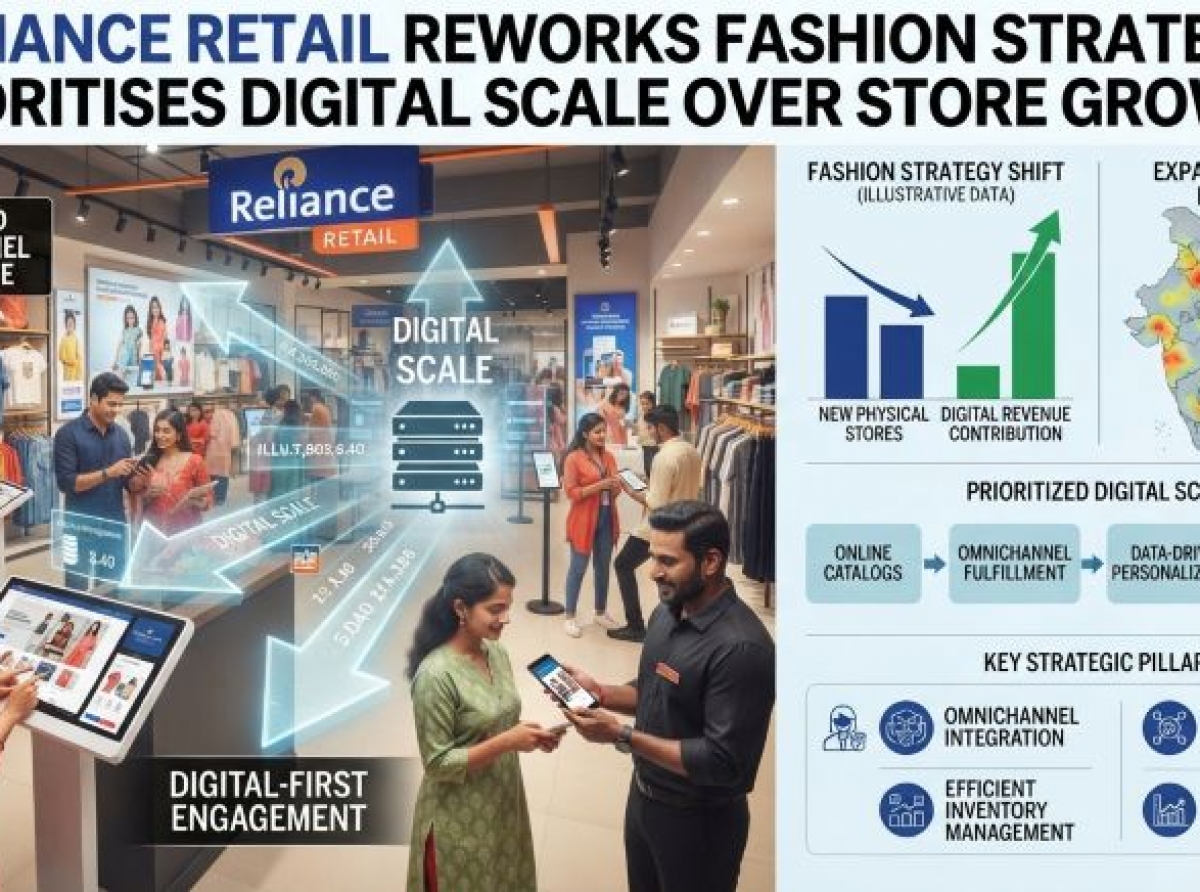
India’s largest organised retailer is relooking its fashion and lifestyle strategy, shifting focus from aggressive physical expansion to digital distribution, private labels and tighter store economics. Reliance Retail Ventures Ltd (RRVL) is rationalising underperforming outlets while directing capital towards higher-return formats, supply chain efficiencies and its e-commerce platform AJIO.
The shift reflects changing financial model in India's apparel market. Persistent cotton price volatility, currency depreciation and rising imported fabric costs have squeezed sourcing margins. At the same time, competition from value-fashion chains such as Trent's Zudio and Landmark Group's Max Fashion has intensified, particularly in Tier-II, III markets.
With rentals, inventory costs and promotional spending rising, Reliance is moving away from a square-footage-led expansion model. The priority is now profitable growth across physical and digital channels.
Capital discipline in focus
Reliance Retail's scale remains formidable, but its operating strategy is mostly centred on productivity rather than store count.
Table: Reliance Retail FY26 operational & strategic outlook
|
Channel |
Performance |
Significance |
|
Gross Revenue (FY26) |
Rs 3,70,026 crore |
Growth across fashion, electronics, and grocery |
|
Retail Network |
20,169 stores; 78.4 million sq. ft. |
Store rationalisation and focus on higher returns |
|
AJIO |
Multi-million active SKU catalogue |
Expansion across fast fashion, D2C, and premium labels |
|
Private Labels |
Avaasa, DNMX, Netplay, Performax |
Higher margin control and sourcing efficiencies |
|
Omni-commerce |
JioMart transactions up 38.8% |
Stores support local fulfilment and digital delivery |
The strategy involves tightening return-on-capital-employed (ROCE) thresholds for physical locations. Stores that fail to deliver adequate productivity are candidates for lease renegotiation, downsizing or closure. New investments are increasingly directed towards locations with stronger catchments and higher revenue potential. This approach also reflects a broader shift in retail strategy. Physical stores remain important for discovery, experience and customer acquisition, but their role is expanding beyond conventional selling space.
Private labels protect margins
Private labels are central to Reliance's margin strategy. Brands like Avaasa, DNMX, Performax and Netplay gives the retailer greater control over product development, sourcing, pricing and inventory. Reliance can bank on its parent group's synthetic and blended textile capabilities to strengthen sourcing efficiencies and manage product costs. Unlike third-party merchandise, proprietary brands offer greater flexibility over pricing and gross margins.
The company is also using a multi-format strategy to cover different consumer segments. Yousta targets younger, value-conscious shoppers with fashion positioned largely below Rs 999. Its proposition relies on affordable pricing, frequent merchandise rotation and localised assortments. The format competes directly with Zudio and other value-fashion chains.
At the premium end, Azorte targets consumers seeking contemporary fashion and a more experiential shopping environment. It positions Reliance against international fast-fashion retailers such as Zara and H&M.
The acquisition of regional fashion operators, including V-Retail's Centro business in southern India, further strengthens its reach across consumer segments. The objective is to build a portfolio in which different formats serve distinct price points while private labels provide a common margin advantage.
Stores become fulfilment hubs
Reliance is also rethinking the operational role of its physical network. Rather than treating every outlet exclusively as a retail destination, the company can use selected stores as fulfilment points for AJIO and JioMart orders. Surplus space in larger Trends outlets can support local inventory storage, packing and last-mile dispatch.
This model allows retailers to extract additional value from existing leases while reducing delivery distances and fulfilment costs. For Yousta, the emphasis is on locations outside expensive premium high streets, including suburban commercial centres, university clusters and secondary retail markets. Technology-led inventory management, digital discovery and checkout systems support operating efficiency. The broader objective is to integrate physical distribution with digital demand rather than build two separate retail infrastructures.
AJIO strengthens digital reach
AJIO remains an important pillar of Reliance's fashion strategy. Its expanding catalogue spans international brands, domestic designers, emerging direct-to-consumer labels and Reliance's proprietary portfolio. The wider Reliance Brands business also gives access to global brands such as Superdry, Armani and Balenciaga, with Indian designer labels including Manish Malhotra and Ritu Kumar. This combination gives AJIO access to multiple price segments, from affordable fashion to premium and luxury merchandise.
Meanwhile, JioMart's reported 38.8 per cent transaction growth underlines the potential of Reliance's broader digital ecosystem. Its physical retail network offers an existing distribution backbone for local fulfilment and cross-category commerce. The opportunity lies in using customer data, inventory visibility and integrated logistics to improve conversion, inventory turnover and delivery economics.
Competition makes efficiency critical
Despite its scale, Reliance faces mounting pressure across the organised apparel market. Value retailers are expanding aggressively into smaller cities, forcing established players to compete on price, merchandise freshness and store productivity.
Currency movements have also increased the cost of imported accessories and technical fabrics, while discount-led competition threatens realised margins and average transaction values. Reliance's response signals a more disciplined approach to growth. Store expansion will remain part of the strategy, but capital allocation is increasingly tied to productivity, format economics and digital integration.
With 20,169 stores covering 78.4 million sq. ft. and FY26 gross revenue of Rs 3,70,026 crore, Reliance Retail has the scale to pursue an integrated retail model. The next phase, however, will be determined less by how many stores it opens and more by how effectively it monetises its existing network, strengthens private labels and converts digital reach into profitable growth.











 Get in Touch!

