
From ghost malls to fulfilment engines China’s retail space rewiring enters a new phase
18 May 2026, Mumbai
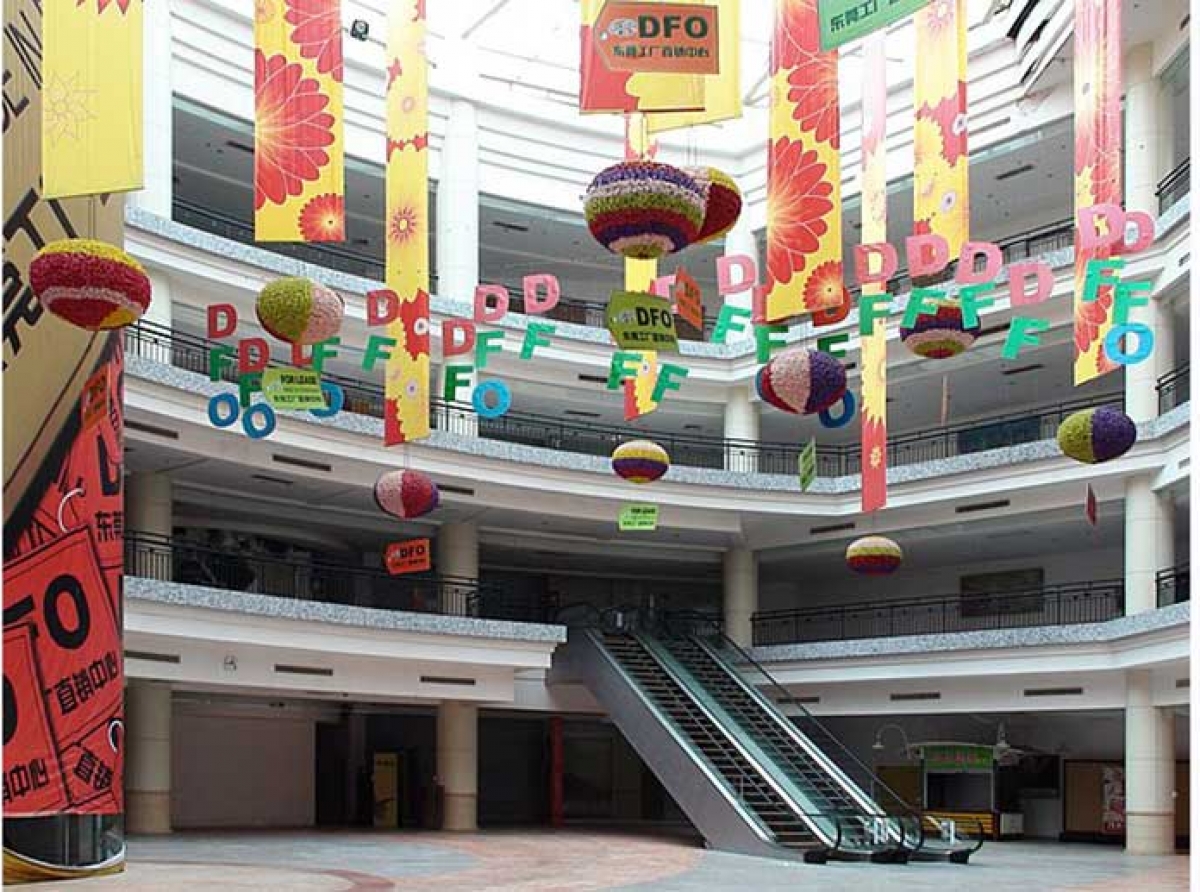
China’s retail economy has entered a paradoxical phase where macro expansion and micro distress are happening simultaneously. Total retail sales of consumer goods rose 3.7 per cent to 50.12 trillion yuan in 2025, highlighting the continued depth of domestic demand. Yet beneath that topline growth lies a bifurcated commercial reality. Premium shopping districts in top-tier cities are tightening as luxury and experiential formats hold value, while across Tier-II, III cities, underutilized malls, once monuments to China’s property-led consumer boom are being forced into reinvention.
This contrast is less a cyclical slowdown than a redesign of retail economics itself. Traditional mall economics, built around footfall monetization, anchor tenancy and discretionary browsing, are increasingly misaligned with a consumer market that has become digitally fragmented, value conscious and algorithmically influenced. The ‘ghost mall’ phenomenon, once treated as a symptom of overbuilding, is increasingly understood as the physical manifestation of a broader decoupling between old retail infrastructure and new consumption behavior.
The consumer split widens
Many experts describe this phenomenon as a split-screen consumer economy. On one side sits the premium urban shopper gravitating toward luxury, exclusivity and immersive retail. On the other is a fast-growing mass segment prioritizing utility, personalization and digitally mediated discovery. The middle particularly conventional department store-led fashion retail has become the most vulnerable space.
That vulnerability is reflected in operating data. Offline retail sales fell 5 per cent by late 2025 even as online segments grew 18.5 per cent, largely due to content-commerce ecosystems led by platforms such as Douyin and Xiaohongshu. For retailers, the economics are unforgiving: every 10 per cent rise in e-commerce penetration has translated into an estimated 3.7 per cent decline in physical store productivity, compressing profitability for traditional mall-based operators. This difference is further seen in format-level performance.
Table: Retail performance by format (YTD 2025-26 growth)
|
Format type |
Growth rate (%) |
Market sentiment |
|
Warehouse Clubs |
+25.0 |
Aggressive Expansion |
|
Convenience Stores |
+6.4 |
Resilient/High Frequency |
|
Specialty Stores |
+4.8 |
Niche/Targeted |
|
Online (Physical Goods) |
+6.5 |
Dominant Channel |
|
Department Stores |
+0.9 |
Stagnant/Declining |
The table reveals where capital is concentrating. Warehouse clubs have emerged as the highest-growth channel, benefiting from scale-led value propositions and membership economics. Convenience stores continue to outperform through frequency-led demand and neighborhood embeddedness, while specialty stores remain relevant where category expertise creates defence. Department stores, in contrast, have become symbolic examples of stagnation, unable to compete either with digital convenience or premium experiential retail.
Membership models rewrite productivity
Perhaps no operator shows the new logic more clearly than Sam's Club. In a market littered with underperforming mall assets, Sam’s Club has positioned itself not as a retailer dependent on traffic, but as a high-efficiency hybrid infrastructure network.
With only 60 stores, the company projected cumulative sales above 120 billion yuan by the end 2025, a 20 per cent year-on-year growth. This performance is not simply a function of merchandise assortment or consumer value perception. It is rooted in logistics architecture. The company’s forward warehouse model, scaled through 455 micro-fulfilment nodes by mid-2025 under Walmart has transformed stores into distribution hubs. More than half of Sam’s Club China revenue now flows through online channels, yet those sales remain anchored in physical assets. The store, in this model, no longer functions primarily as a sales floor. It functions as inventory node, delivery accelerator and customer acquisition platform.
That distinction is increasingly important because it reframes the future of retail property. The question is no longer whether a store generates sufficient walk-in productivity, but whether a physical footprint can generate network efficiency.
Concrete finds a second life
For weaker mall assets unable to attract destination tenants or premium repositioning, a different future is emerging, one shaped less by retail revival than by asset conversion. Vacant mall space across provinces is increasingly being repurposed into infrastructure supporting what policymakers describe as ‘new quality productive forces’. This phrase, central to China’s industrial modernization discourse, is now entering retail real estate.
Food courts once built for discretionary dining are becoming live-streaming production studios, serving influencer commerce that operate continuously rather than according to shopping hours. Large-format basements and parking structures are being converted into automated last-mile logistics centers, integrating idle retail square footage into urban delivery networks. Elsewhere, brands such as Anta Sports are deploying compact phygital formats designed not for inventory-heavy merchandising but for demand generation linked to online fulfilment.
These models represent more than opportunistic reuse. They imply a new valuation logic for distressed retail assets, where worth is determined not by leasing spreads alone but by logistics relevance, digital commerce enablement and adaptive industrial use.
Property distress an infrastructure opportunity
This evolution is unfolding against a broader property-induced slowdown that has pressured developers to rethink commercial assets once built around speculative assumptions of endless traffic growth. As leasing sentiment improves in Shanghai and Beijing, regional developers face less a temporary vacancy problem than a liquidation challenge. That has pushed local governments into a more active role, using incentives and zoning flexibility to facilitate conversions that preserve economic productivity even when traditional retail demand cannot.
What emerges is a fundamental redefinition of the shopping center. In its legacy form, the mall was a destination for demand aggregation. In its emerging form, it is increasingly part of supply-chain architecture. That shift may ultimately explain why China’s ghost mall paradox is less contradictory than it appears. Empty malls and booming retail sales are not opposing signals; they reflect growth shift away from legacy formats toward more efficient channels and infrastructures.
Growth moves downstream
The long-term implications extend beyond real estate. With China’s retail market projected to grow at an 8.9 per cent CAGR till 2030, growth is expected to be concentrated not in broad-based physical expansion but in Tier-III value consumption, membership-led discount ecosystems and high-efficiency omnichannel operators.
That concentration matters because it signals a structural rather than cyclical redistribution of returns. Capital is moving toward formats that collapse the distinction between commerce and fulfilment, while conventional retail assets lacking such integration face accelerating obsolescence.
For global retailers and developers, China is becoming a test case in what happens when the store ceases to be the center of retail economics. In that model, success belongs less to those who control the most square footage than to those who can convert square footage into infrastructure. The future of China’s retail floor, in other words, may not be measured by traffic at all, but by throughput. And in that transition, the ghost mall may prove not the endpoint of a failed model, but the raw material of a new one.










 Get in Touch!
