
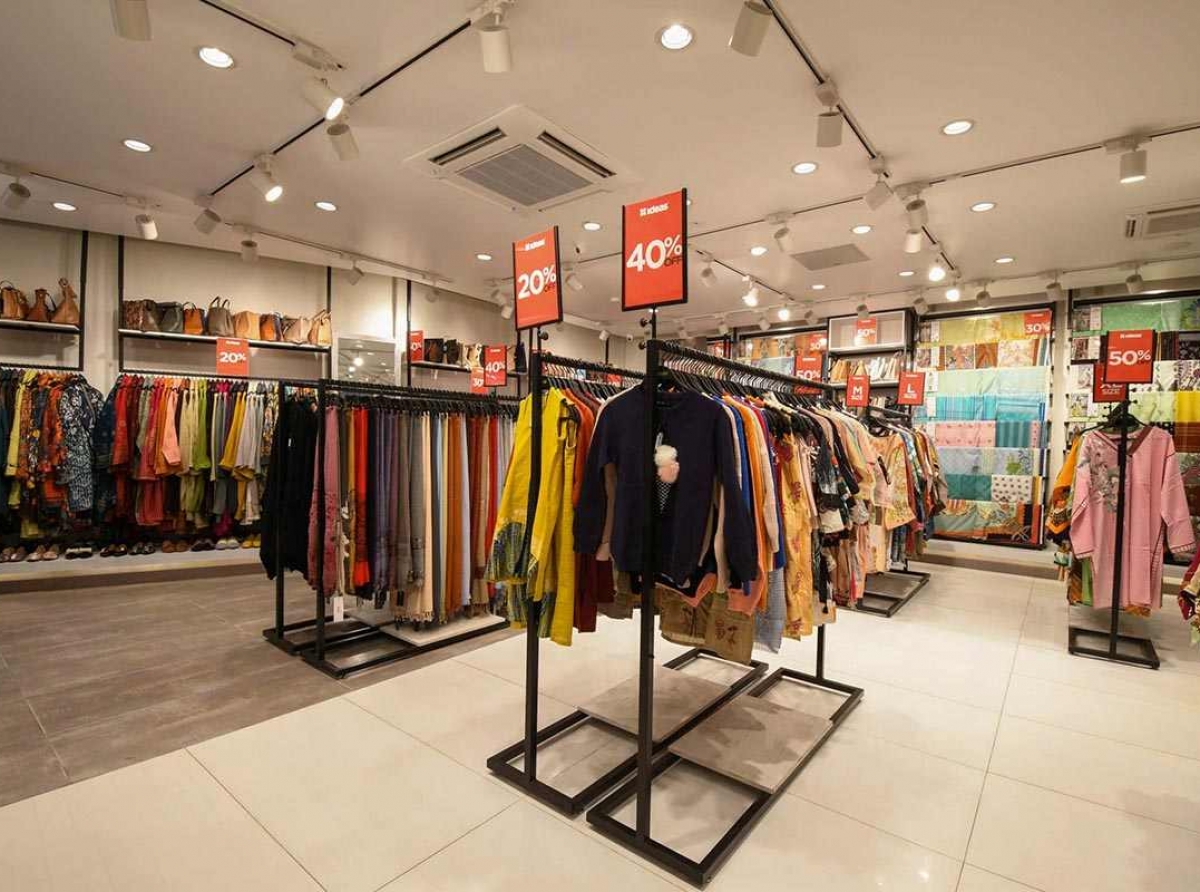
India’s organised retail real estate market has entered a phase of scale, with larger shopping centres, office-integrated retail and fashion-led tenant mixes reshaping the business of physical stores. Organised commercial retail stock across the country’s top 12 urban markets has reached 186.2 million sq. ft, almost nine times the footprint recorded two decades ago.
Shopping malls account for the largest share at 114.3 million sq. ft, followed by office-led retail at 51.7 million sq. ft and high streets at 20.2 million sq. ft. The concentration is particularly strong in cities where technology, corporate employment and rising household incomes converge. Bengaluru leads with 29.2 million sq. ft of organised stock, followed by Gurugram at 27.4 million sq. ft, Hyderabad at 24.8 million sq. ft and Mumbai at 23.8 million sq. ft.
Table: Organised commercial retail space across top cities
|
Market |
Total organised stock (mn sq ft) |
Mall Space (mn sq ft) |
Office-Led Retail (mn sq ft) |
High Streets (mn sq ft) |
|
Bengaluru |
29.2 |
16.4 |
10.1 |
2.7 |
|
Gurugram |
27.4 |
14.1 |
9.8 |
3.5 |
|
Hyderabad |
24.8 |
13.9 |
8.7 |
2.2 |
|
Mumbai |
23.8 |
15.6 |
5.4 |
2.8 |
|
Balance 8 Markets |
81 |
54.3 |
17.7 |
9 |
|
Total Top 12 |
186.2 |
114.3 |
51.7 |
20.2 |
Fashion takes the floor
The bigger change is taking place inside shopping centres. Apparel and fashion have increased their share of mall space from 25 per cent in the 2013-15 period to 35 per cent in 2023-025. The change reflects the evolution of fashion stores from transactional outlets into destination formats. Most brands want contiguous floor plates large enough to accommodate women's, men's and children's apparel alongside footwear, accessories, beauty and experiential elements. At the same time, shopping centres are broadening their consumer proposition. Food and beverage space has grown from 11 per cent to 15 per cent, while essentials and modern grocery have increased from 3 per cent to 11 per cent.
Table:
|
Retail category |
Space share (2013-15) |
Space share (2023-25) |
Operational focus |
|
Apparel & Fashion |
25% |
35% |
Monobrand flagships, fast-fashion, performance activewear |
|
Food & Beverage (F&B) |
11% |
15% |
Dining hubs, microbreweries, experiential cafés |
|
Essentials & Modern Grocery |
3% |
11% |
Gourmet supermarkets, daily essentials, pickup hubs |
|
Department Stores & Others |
61% |
39% |
Compact footprints, tech integration, specialty beauty |
Shweta Rao, Head of Retail Tenant Strategy at commercial advisory firm points out the modern shopping centre is no longer an apparel rack under a concrete roof. Apparel brands are taking up 35 per cent of aggregate centre volumes because they are using large-scale formats to merge physical engagement with digital catalogues. The implication for developers is significant: fashion is becoming an anchor around which dining, entertainment and other consumer experiences can be organised, rather than simply another category occupying mall space.
Mega malls move up the pipeline
The next phase of supply is likely to reinforce this trend. Over 40.4 million sq. ft of shopping mall space is currently under construction, with Hyderabad and Gurugram together accounting for 51 per cent of the upcoming inventory.
More importantly, new malls are getting substantially larger. The average mall scheduled for delivery between 2026 and 2030 is estimated at 0.59 million sq. ft, more than twice the 0.25 million sq. ft average of malls developed before 2000.
For fashion retailers, this changes the store-size equation. Conventional 1,500 sq. ft units are being supplemented by 10,000-30,000 sq. ft stores and duplex formats. Global brands such as Zara, H&M and Uniqlo, as well as domestic chains including Reliance Trends and Westside, can use these larger spaces to create broader assortments and stronger visual merchandising.
The larger footprint also supports the transition from store-as-outlet to store-as-experience, with digital catalogues, assisted selling, click-and-collect and integrated beauty and accessories propositions becoming part of the physical environment.
Tech corridors become retail hubs
Office-led retail is emerging as another major engine of expansion. Such developments added 15.4 million sq. ft between 2021 and 2025, taking the overall office-led retail inventory to 51.7 million sq. ft. These projects effectively insert retail into Grade-A technology corridors and corporate campuses. For fashion and lifestyle brands, that creates a different traffic profile from conventional malls.
Weekday lunch-hour and post-work demand can support categories such as office casualwear, formalwear, footwear, travel accessories and athleisure. Retailers also gain access to affluent working populations without depending entirely on destination-led weekend traffic. This makes office-led retail particularly relevant as work patterns become more hybrid but office districts retain significant concentrations of high-income consumers.
Rents make store economics critical
The expansion, however, is not uniform. Mall rents across the 12 tracked markets range from around Rs 140 per sq. ft a month in peripheral locations such as Ghaziabad to Rs 438 per sq. ft in core Mumbai assets.
Vacancy also varies sharply. Institutional Grade-A developments report vacancy as low as 1 per cent in Thane and around 4 per cent in Mumbai, Hyderabad and Bengaluru, while Gurugram is at 13.6 per cent amid faster supply additions. For fashion retailers, the result is greater emphasis on store productivity rather than footprint alone. Hybrid lease structures combining fixed rentals with revenue-share components are gaining relevance, with revenue shares typically ranging between 7 per cent and 12 per cent. Store-level EBITDA thresholds are increasingly becoming a prerequisite for major capital expenditure decisions.
Trent shows the two-speed model
Tata’s retail arm Trent shows how retailers can respond to this changing real estate landscape through differentiated formats. Its Zudio business uses standardised 6,000-10,000 sq. fts tores to penetrate suburban corridors and emerging micro-markets, while Westside occupies larger 18,000-30,000 sq. ft anchor positions in premium shopping centres. The model allows the company to pursue two distinct growth pools: value-oriented consumers through a relatively standardised footprint and affluent urban shoppers through larger destination stores.
The broader lesson for India's fashion sector is that expansion is becoming less about simply adding outlets and more about matching store format, location and capital intensity with consumer density and purchasing behaviour.
Physical retail gets more strategic
With 40.4 million sq. ft of mall supply under construction and office districts functioning as consumer destinations, India's organised fashion market is entering a more sophisticated phase of physical expansion.
The next retail cycle is likely to be defined by larger floors, stronger fashion anchors and increasingly integrated physical-digital experiences. For brands, however, more space will only create value where productivity can justify the cost.
India's retail real estate story is therefore shifting from store availability to store economics with fashion brands, developers and landlords all reworking around the same logic: how much consumer value can be generated from every sq. ft.










 Get in Touch!
