
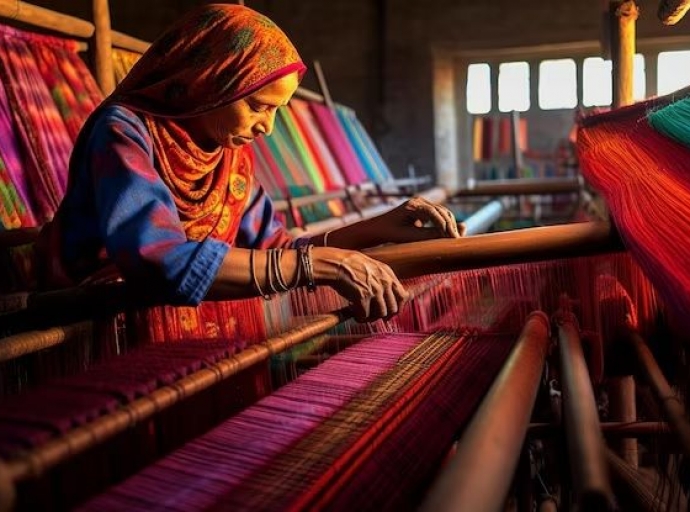
With mass-produced fast fashion facing resistance from eco-conscious consumers, particularly Millennials and Gen Z, handcrafted textiles are no longer seen as cultural artefacts rather they are a fast-growing commercial asset. As per Fortune Business Insights, the global handloom products market is valued at $9.67 billion and is projected to reach $20.39 billion by 2034, at a CAGR of 9.78 per cent. India, with an estimated 6.8 million rural artisans and over 72 per cent female handloom workers, is at the centre of this change. Yet for decades, the paradox has been: while demand for handcrafted textiles have grown globally, the primary producers of this value, traditional weavers remained locked into low-margin labour systems.
Value chain imbalance
In the middle of the handloom sector lies a persistent economic distortion. Most artisans operate as contract workers, earning between Rs 5,000 and 10,000 per month, while final retail values of handcrafted garments multiply several times across intermediaries. This fragmentation has created two inefficiencies. First, artisans rarely participate in design or pricing decisions. Second, the absence of direct market access keeps them dependent on middlemen and informal credit systems. The result has been long-term attrition in the sector, particularly among younger, digitally literate artisans who exit due to limited financial upside.
New incubation blueprint
A new generation of craft incubators is now actively redesigning this value chain. Instead of treating artisans as labour inputs, these platforms are repositioning them as micro-entrepreneurs with ownership over design, pricing, and production decisions. The shift is driven by three interventions: access to working capital, design autonomy, and direct market linkage.
Artisans are no longer advancing raw material costs through debt; instead, they receive upfront order-based funding. Training in cost accounting, inventory planning, and contemporary design iteration further enables them to operate as independent businesses. This model has shown a sharp income change.
Table: Income and structural shift in artisan economy
|
Metric |
Traditional wage-worker model |
Modern artisan-entrepreneur model |
|
Average Monthly Income |
Rs 5,000 -10,000 |
Rs 35,000-70,000 |
|
Role in the Value Chain |
Execution / Manual Labor |
Design Ownership & Pricing Control |
|
Financial Risk / Advances |
Bear raw material costs via credit |
100% advance payments on orders |
|
Primary Market Access |
Local middlemen & wholesale traders |
Global B2B boutique buyers & e-commerce |
The change is not incremental; it shows a restructuring of how rural craft economies interface with global fashion markets.
From fragmentation to integrated supply systems
One of the biggest constraints for international buyers has been inconsistency, irregular sizing, fragmented production timelines, and lack of standardised finishing systems across rural clusters. To address this, incubator-led platforms are now functioning as centralised operational layers. They aggregate diverse craft traditions such as Jamdani weaving, Maheshwari textiles, Ajrakh printing, and regional embroidery systems under a unified production and compliance framework.
These intermediaries manage quality control, tagging, finishing, logistics, and export coordination, effectively absorbing operational friction while preserving creative autonomy at the artisan level. The outcome is a hybrid structure: decentralised production with centralised governance.
The rise of micro-brands
In Maheshwar, Madhya Pradesh, the growth of artisan Shraddha Khedekar is an example of this transformation. Entering the handloom sector with no hereditary background, she initially worked as a contract weaver earning around Rs 5,000 per month after formal training at a local institution. Her transition began when she joined an artisan incubation platform that shifted her from execution-based weaving to independent product development. Specialising in cotton textile design, she began producing her own collections and accessing structured B2B demand channels.
Today, her monthly earnings have crossed Rs 13,500, with a clear growth path as she plans to onboard additional weavers. Her evolution highlights a critical shift: artisans are no longer just producers, they are becoming employers.
West Bengal’s silk clusters and the input revolution
In West Bengal’s silk weaving belts, particularly across Tussar, Mulberry, and Eri silk clusters, artisans depended on local credit networks that inflated raw material costs and reduced final margins. With intervention, weavers now access certified organic yarns through clean working capital systems. This removes dependence on predatory credit cycles and allows pricing autonomy at the production level.
Early impact assessments indicate a 30 per cent baseline increase in artisan earnings, alongside improved income stability. In several clusters, one in three weavers reported sustained financial uplift, leading to reinvestment in household infrastructure and local employment creation.
The challenges ahead
Despite strong demand from premium global fashion brands, the artisan-entrepreneur model faces several headwinds. Volatile yarn pricing, rising raw material costs, and competition from machine-made imitations continue to pressure margins. Additionally, scaling from incubated micro-enterprises to fully independent brands requires sustained access to capital and long-term business mentorship; without this, many artisans risk plateauing within semi-supported systems. The next phase of growth will depend heavily on deeper integration with global sustainable fashion supply chains and impact investment ecosystems.
The entry of institutional capital
The rising credibility of artisan-led business models has attracted impact investors and venture capital participation. Dedicated craft incubators are increasingly viewed as supply-chain infrastructure rather than niche social enterprises. This shift is also reshaping social aspirations in rural weaving regions. In several clusters, families that once discouraged entry into handloom work are now encouraging formal design education, positioning the next generation for leadership roles in fashion entrepreneurship rather than manual labour.
Karghewale and the scaling model
Karghewale represents one of the emerging institutional platforms in this space. Operating across 13 states, including Madhya Pradesh, West Bengal, Bihar, and Gujarat, the company aggregates decentralised craft clusters into a unified production network. With backing from institutional investors such as NextPath Ventures and Hero Enterprises’ Bridge Incubator, the platform supplies ethically certified fabrics to international boutiques and sustainable fashion brands. Its core strategy is consolidation turning fragmented artisan networks into a globally reliable sourcing ecosystem.
Thus the transformation of India’s handloom sector is no longer a narrative of preservation alone. It is evolving into a structural economic shift where artisans are becoming business owners, employers, and brand creators. What was once a low-margin rural occupation is gradually being repositioned as a high-value entrepreneurial ecosystem anchored in sustainability, global demand, and institutional capital. The loom, is no longer just a tool of production. It is becoming a vehicle for legacy creation.
















 Get in Touch!
