
Stitching the Future: How GTE Bengaluru 2026 set a new benchmark for smart apparel manufacturing
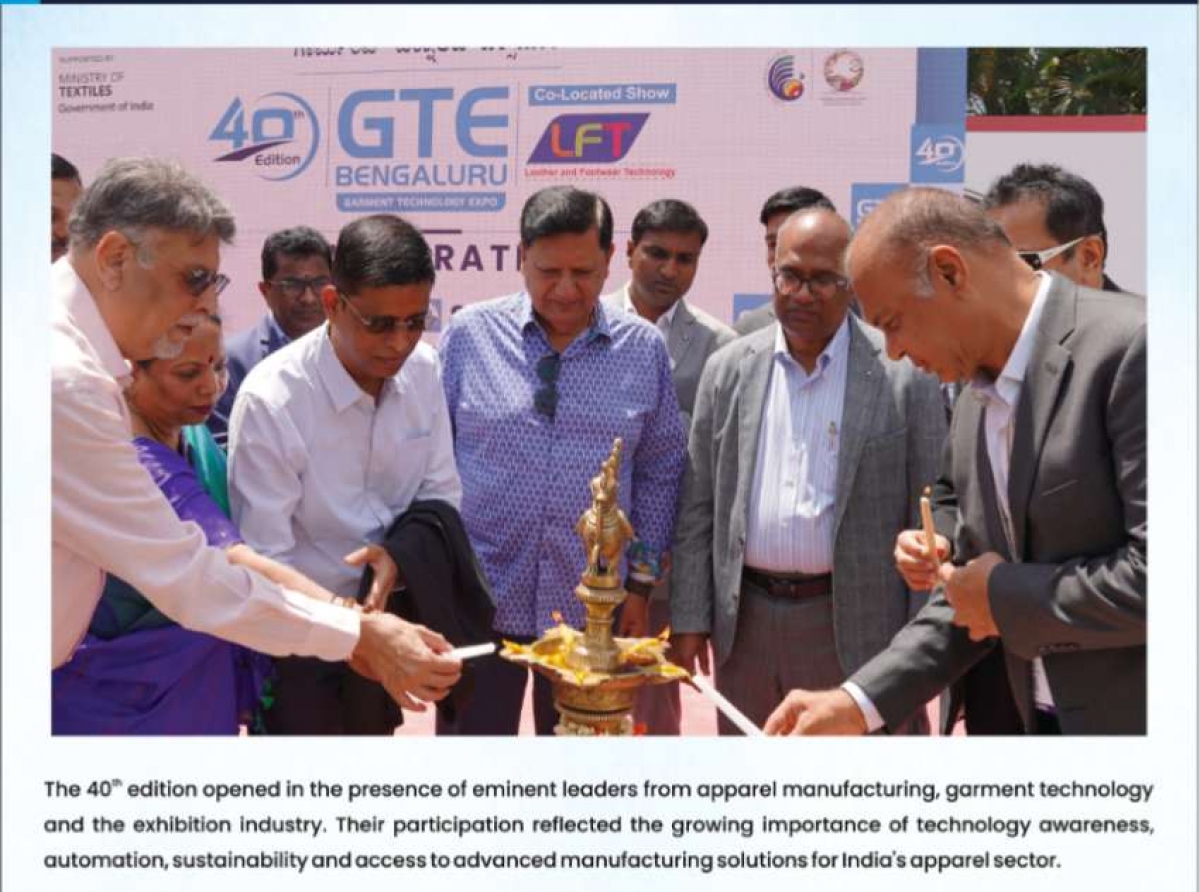
Across 70,000 square feet at Gayatri Vihar Palace Ground, the hum of computer-guided cutting and multi-head embroidery marked a decisive turning point for India’s textile heartland. The 40th edition of the Garment Technology Expo (GTE) 2026 Bengaluru, co-located with the Leather & Footwear Technology Expo (LFT), concluded its September 18–20 run after drawing more than 13,000 trade buyers and showcasing 225 brands. Supported by the Ministry of Textiles and backed by a 26-year legacy, the platform brought global manufacturing innovations directly to regional production clusters.
"Bengaluru represents an important milestone in our journey of taking advanced garment technology directly to India's key manufacturing hubs," affirmed Shri Inderjit Singh Sahni, Chairman & Managing Director of GTE, noting that the strong response reinforces the urgent need for technology awareness and access across domestic hubs. Dr. Rakesh Kumar, Chairman of IEML, emphasized that GTE delivers direct access to solutions that "enhance global competitiveness, productivity and sustainability," while GTE Joint Managing Director Rathi Sahni highlighted that the milestone show served as a live staging ground where apparel makers could evaluate advanced machinery for immediate factory integration.
Engineering the intelligent, deskilled assembly line
The exhibition floor reflected a structural migration away from isolated machines toward fully connected, deskilling production lines engineered to counter labor shortages and fabric waste. Onyx Solution connected CAD design directly to the cutting room via CREA CAD Version 15, Z-emotion’s 3D and AI modeling tools, and automated spreading systems. Specialized sewing automations solved high-friction operations: HCA demonstrated its DY-G36 Automatic Pocket Welt Machine featuring an 80–100W laser and infrared positioning, while FDM presented automated attachments for bra straps, sleeve plackets, and pocket setting alongside computerized auto-cutters. Sakho Industries introduced Italian pocket-setting and fusing stations, while Master Enterprises displayed continuous Roll-to-Roll fusing units.
"Today, garment manufacturers are looking for complete solutions rather than individual machines," observed S. Eswaran, Vice President of Sales at Mehala Machines, which exhibited German-technology AI spreaders, cutters, and the Orbito Auto Hanger System to prove how integrated material handling curbs manpower dependency. Addressing practical factory realities, Alok Desai of DEBMAC India noted: "Our journey into garment automation began on the factory floor, where we experienced the everyday challenges of skilled labour dependency... practical, factory-tested innovation, supported by reliable service, is what the Indian garment industry needs to become more competitive". Eshwar Rao, Managing Director of Sanora Sewtec, cautioned against a one-size-fits-all mindset, stressing that long-term success hinges on tailoring affordable pre-cutting, cutting, and sewing automations to each manufacturer's unique operational floor.
High-precision embellishment and resource-neutral finishing
Value addition and resource-neutral wet processing emerged as central pillars of product differentiation. HSW unveiled what was positioned as India’s first high-speed single-head computerized embroidery unit, while Yuemei Sunrise displayed mixed-head and bead machines. "Embroidery today is no longer limited to decoration; it has become an important element of product differentiation and value addition in fashion," explained Vinod Kumar L., Managing Director of Yuemei Sunrise LLP, noting strong buyer demand for intricate designs delivered at industrial speed. Heritage techniques kept pace, with Rajdhani Technology demonstrating mechanized Zardozi craftsmanship alongside advanced stitchers from Kansai and CutNStitch.
Sustainability defined the finishing sector, where Ramsons exhibited green electric steam generators, ozone and nebulizing equipment, low-liquor dyeing, and AI-assisted fabric checkers. A Ramsons spokesperson highlighted GTE as an impactful forum that "simplifies sourcing, enables meaningful buyer interactions, and gives exhibitors exceptional visibility among key decision-makers". Sunshine brought automated laundry systems, while Amith Garments provided analytical instruments—such as Aqua-Boy moisture meters, fiber microscopes, and digital pick counters—to enforce precision quality control.
Digital factory architecture and global sourcing
Data integration formed the operational spine of modern factory management through platforms like Jenix Cloud’s TPCS, a SaaS PLM, ERP, and MES suite providing departmental dashboards and end-to-end garment traceability. Industry leaders pointed out that digital transparency is now essential to sustaining global trade relevance. "The garment industry is entering a phase where technology adoption will determine its global competitiveness," stated Pavan Kapoor, Chairman of IIGM Private Limited, commending manufacturers' willingness to invest for long-term productivity and quality. Naveen Agarwal, CMD of SAPL Industries, echoed this imperative: "Awareness of automation, sustainability and the machines that are available around the world is very important for the Indian manufacturer, and I think this is the exact platform needed to bring that awareness".
For tier-one apparel exporters, localized technology access offered major commercial advantages. "I don't think you have to go out of the country to be able to do all this," remarked Siva Ganapathi, Managing Director of Gokaldas Exports. "You can sit here and buy whatever you want at the best prices, and it looks very, very promising". Gokaldas Exports COO Balakrishna Shetty confirmed that evaluating live automation at GTE is instrumental to scaling domestic and overseas operations efficiently. Visiting enterprise buyers affirmed the venue's utility, noting that live demonstrations made complex technology sourcing straightforward and accessible under one roof.
Value-Chain convergence and the Bharat Tex corridor
The event also functioned as a strategic bridge across the textile ecosystem and academia. Student delegations and faculty from NIFT Bengaluru, Chennai, Kannur, and the JD Institute of Fashion & Apparel analyzed live automation to connect design theory with production realities. Concurrently, Bharat Tex leveraged the showcase to connect with southern manufacturers, securing 39 verbal exhibitor confirmations across the three days for Bharat Tex 2027 in New Delhi, while fielding strong local interest to host future editions directly in Bengaluru.
"Bengaluru has shown that manufacturers are ready to move decisively towards smarter production," concluded GTE Director Ambrish Chopra, affirming that the show's reception reinforces plans to deepen ties across the southern apparel belt. Supreme Infrastructures India Ltd. concurred, praising the platform's growing industry relevance. The technology dialogue now heads north, as organizers prepare for the 41st Garment Technology Expo (GTE Delhi-NCR 2027), scheduled for March 26–29, 2027, at the India Expo Centre & Mart in Greater Noida.











 Get in Touch!
