
Tier II demand grows but COD costs challenge fashion’s online growth
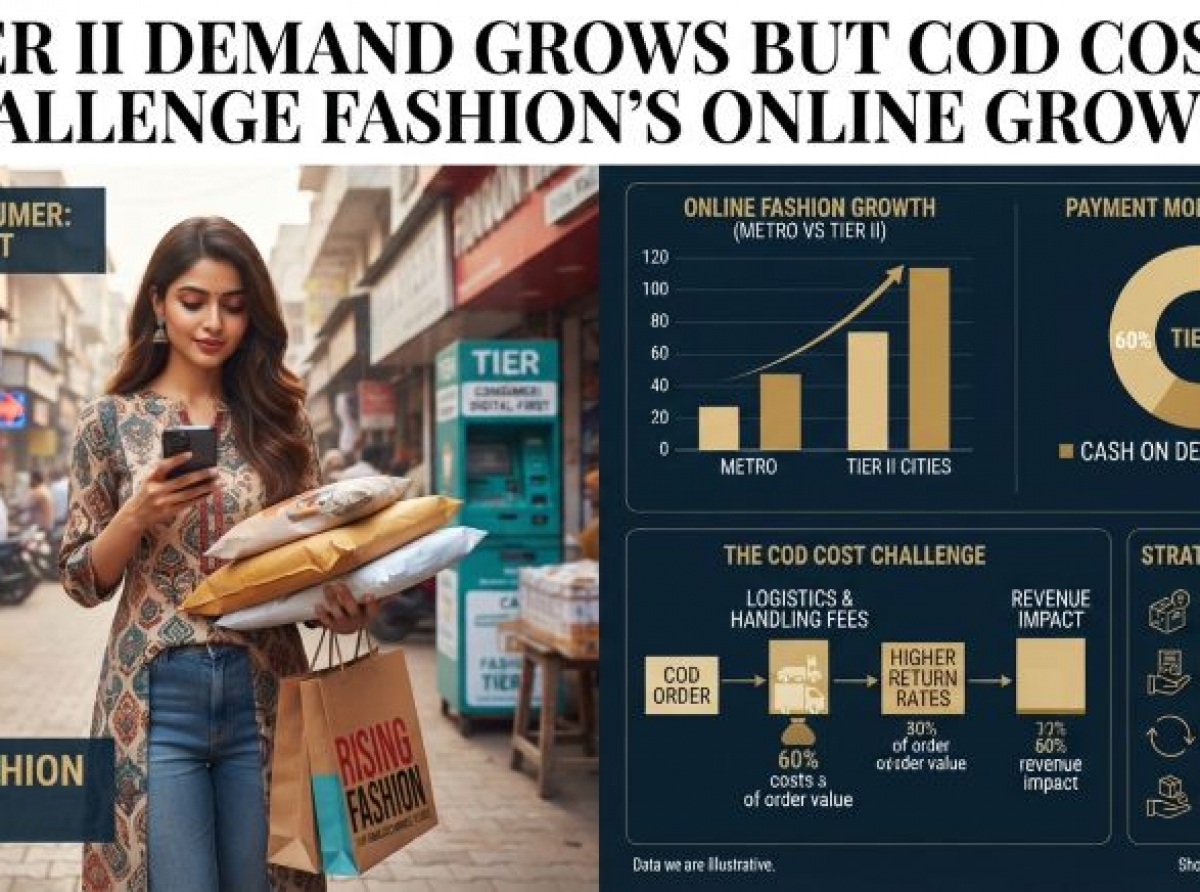
India’s digital fashion brands are facing growing unit-economics challenge this festive season as rising customer acquisition costs, lower order values and expensive failed deliveries erode the profits of online growth. The pressure is particularly acute in Tier II, III markets, where demand is growing but cash-on-delivery (COD) continues to expose merchants to high return-to-origin costs.
For emerging digital-first apparel labels, the equation is becoming harder to sustain: acquiring a customer can cost over Rs 500, even as average order values decline from around Rs 2,200 to below Rs 1,600. With garment gross margins estimated at 55-60 per cent, the cost of winning a first-time buyer can consume a substantial share of the margin available to cover fulfilment, returns, discounts and operating expenses. The festive season is therefore testing a vital assumption of digital fashion retail: that higher order volumes automatically translate into profitable growth.
Acquisition costs rise
Meta and Google advertising auction rates have reportedly increased by nearly 20 per cent this festive quarter, intensifying competition for consumer attention. At the same time, shoppers are moving away from larger discretionary baskets towards fewer, more considered purchases, including individual statement garments. This combination is weakening first-order business. A merchant spending more than Rs 500 to acquire a customer who places an order worth less than Rs 1,600 has limited room to absorb shipping costs, payment charges, promotional discounts and potential returns.
The initial transaction may generate gross profit on paper, but that does not necessarily translate into a positive contribution after marketing and fulfilment expenses. For digital-first brands, profitability increasingly depends on repeat purchases, customer retention and the ability to recover acquisition costs over subsequent transactions.
The critical factor is no longer simply the cost of acquiring a customer, but how quickly that investment is recovered. A 90-day repeat-purchase cycle can help improve customer lifetime value, but only if buyers return consistently and subsequent orders generate adequate contribution margins.
COD complicates growth
The challenge is sharper beyond metros. Tier II, III cities, including Jaipur, Surat, Lucknow and Coimbatore, reportedly account for nearly 65 per cent of seasonal apparel dispatch volumes. Yet over 70 per cent of festive orders from non-metro pin codes are said to be placed through COD. Industry estimates put festive COD return-to-origin (RTO) rates at 28-34 per cent. Failed deliveries can result from impulse cancellations, transit delays, customers being unavailable or refusing parcels at the doorstep.
For retailers, the financial consequences extend beyond lost sales. Outbound freight, return shipping and handling expenses accumulate while inventory remains tied up in transit. Seasonal merchandise may also lose value before it can be inspected, repackaged and returned to sale.
The resulting impact can be particularly unforgiving for trend-sensitive apparel. A failed COD shipment can wipe out the contribution earned from several successful deliveries, depending on order value, freight rates and the extent of the losses. “India remains a value-led market where consumers are buying fewer items with far greater deliberation,” said Ajai Thandi, Co-founder, consumer brand Sleepy Owl, highlighting the need to balance seasonal expansion with the rising cost of visibility. For fashion merchants, the implication is clear: non-metro demand remains a significant growth opportunity, but order quality, delivery success and customer commitment matter as much as dispatch volumes.
Stores become a hedge
As digital advertising becomes more expensive, physical retail is regaining strategic importance in the economics of customer acquisition. Exclusive brand outlets (EBOs), regional departmental stores and shop-in-shop formats offer fashion labels alternative routes to reach consumers without relying entirely on search and social-media auctions.
Physical stores can also encourage product trials, improve consumer confidence and support larger purchases. The claim that average ticket sizes can rise by more than 35 per cent in physical channels, however, will depend on the brand, category and location rather than representing a universal retail advantage.
Their operational role may be equally important. Stores can serve as local fulfilment and inventory nodes, enabling shorter delivery distances, faster replenishment and more efficient exchanges. Where systems permit, local inventory can also reduce dependence on long-distance shipping and help contain reverse-logistics costs.
Physical retail does not eliminate the cost of customer acquisition or guarantee lower returns. Rent, staffing, inventory and store-level operating expenses introduce their own financial commitments. But a well-utilised store can spread these costs across walk-in sales, repeat visits, fulfilment and brand-building, reducing dependence on paid digital traffic alone.
Omnichannel takes priority
Neeman’s exemplifies the shift towards combining digital reach with a physical retail presence. Founded in Hyderabad in 2018, the footwear brand built its proposition around Australian merino wool and recycled materials, targeting working professionals across metropolitan and emerging markets.
The company is pursuing an omnichannel expansion plan involving 500 company-owned outlets, with a stated ambition to reach a Rs 1,000 crore annual revenue run-rate by FY30. These are forward-looking targets, not evidence of realised scale or profit. For footwear and apparel brands alike, the strategic question is how to deploy stores where they can improve conversion, build customer trust and support local fulfilment without creating an unsustainable fixed-cost base.
The emerging model is not a retreat from e-commerce. It is a reworking of how online demand is acquired, fulfilled and retained. Digital channels can continue to generate reach, while physical outlets provide product discovery, trials, exchanges and local inventory support. Ultimately, the Rs 500 acquisition threshold is a warning against equating customer growth with economic value. In a market where consumers are becoming more selective and COD remains entrenched across non-metro India, fashion retailers will need tighter delivery controls, more disciplined marketing and stronger repeat-purchase rates.
The winners will not necessarily be the brands that dispatch the most festive orders, but those that convert demand into delivered sales, repeat customers and sustainable contribution margins.










 Get in Touch!

