
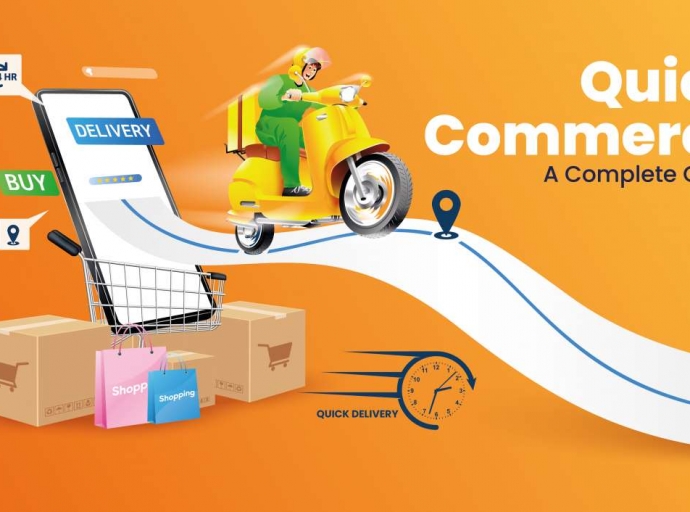
What started as a delivery model for groceries and household essentials is rapidly transforming India's fashion retail. Quick commerce platforms, built around dark stores and ultra-fast fulfillment, are reshaping consumer expectations and forcing apparel brands to rethink supply chains that were traditionally designed around seasonal planning and long replenishment cycles.
The shift is more than a new sales channel. It signals a change in how fashion is discovered, purchased, stocked and delivered. As platforms seek larger basket sizes and stronger profitability beyond groceries, apparel has emerged as one of the fastest-growing categories in the quick commerce ecosystem.
End of traditional fashion discovery
India's online fashion market is valued at approximately $17.8 billion and is growing along with a broader e-retail industry and expected to grow at a compound annual rate of more than 21 per cent by 2030. Within this growth, quick commerce has become the industry's most disruptive force.
As per estimates, India now has over 6,200 active dark stores. Non-grocery categories are growing faster than grocery segments, while fashion-related orders have recorded triple-digit growth rates over the past year. The change is being driven largely by younger consumers, particularly Gen Z, who view shopping through the lens of convenience and immediacy.
Traditional fashion e-commerce was built around browsing, comparison, wish lists and delayed gratification. Consumers often spent hours or even days evaluating products before placing orders. Quick commerce has reduce this into a matter of minutes, with shopping sessions frequently completed in under five minutes.
Instead of browsing for inspiration, consumers today are purchasing fashion to solve an immediate need, whether replacing a basic T-shirt, buying rainwear during sudden weather changes, or securing last-minute essentials before an event. The result is a growing shift from aspirational shopping to utility-driven consumption.
Inventory becomes a liability
This new retail scenario creates numerous challenges for apparel companies whose operations were designed around broad assortments and centralized distribution. Traditional fashion retailers have long relied on extensive inventories, seasonal collections and large warehouses. Quick commerce demands the opposite: tightly curated product selections, hyperlocal inventory management and rapid replenishment.
Table: Traditional apparel retail vs quick commerce
|
Operational attribute |
Traditional e-commerce |
Quick commerce |
|
Inventory Structure |
Wide style variety, central warehouse asset |
Narrow SKU focus, micro-fulfillment liability |
|
Replenishment Cycle |
Multi-week or seasonal planning schedules |
Real-time, continuous local inventory injection |
|
Primary Performance Indicator |
Seasonal sell-through percentage |
Hourly unit sales velocity |
|
Fulfillment Timeframe |
24 hours to 5 business days |
10 to 30 minutes door-to-door |
In dark stores where space is limited and every square foot must generate revenue, unsold inventory becomes expensive. As a result, successful brands are abandoning the idea of placing entire collections on quick commerce platforms. Instead, they focus on a small number of high-velocity products such as innerwear, athleisure, basic T-shirts, loungewear and weather-related essentials.
Not every fashion category can move at speed
The economics of quick commerce favour categories with predictable sizing and low return rates. Products such as socks, leggings, basic tees and innerwear perform well because customers know exactly what they are buying and are less likely to return them. More complex categories face greater obstacles. Premium formalwear, tailored garments, occasion wear and high-fashion products require consumers to compare options, evaluate fit and spend time considering purchases. These characteristics conflict with the instant-delivery model. As a result, fashion retailers are segmenting their portfolios. Basics and replenishment products are moving into quick commerce networks, while premium and style-led merchandise continues to rely on traditional e-commerce and physical stores.
New Metric: Hourly inventory turnover
The rise of quick commerce is also changing how apparel executives measure performance. So far retailers focused on seasonal sell-through rates and end-of-season clearance levels. Today, dark store operators monitor inventory movement on an hourly basis. Products that fail to achieve predefined sales velocity targets risk losing shelf space within fulfillment networks. This has increased supply-chain agility from a support function to a competitive advantage.
To succeed, brands are investing in demand forecasting, real-time inventory visibility and localized replenishment systems capable of responding to neighbourhood-level buying patterns. The emphasis is shifting from producing more inventory to moving inventory faster.
Table: Two competing fashion supply chain models
|
Dimension |
Legacy brands (adapting operations) |
Native D2C/micro-manufacturers |
|
Supply Chain Model |
Hybrid allocation: isolating high-velocity SKUs from core wholesale operations |
Hyper-local loops: micro-factories supplying adjacent dark store clusters |
|
Manufacturing Style |
Large minimum-order-volumes with mid-cycle reactive production re-runs |
Small-batch agile runs; 48-hour turnarounds from dye-house to delivery hub |
|
Infrastructural Focus |
Upgrading enterprise resource planning (ERP) systems for real-time local visibility |
Cloud-native APIs linking manufacturing runs to real-time dark store stock counts |
|
Working Capital Risk |
Sizable; risk of localized excess inventory if micro-demand forecasts miss |
Minimal; capital tied up in blank fabric rolls instead of unsold finished goods |
This divergence is creating two distinct groups within the industry: established apparel companies adapting existing infrastructure, and a new generation of agile manufacturers building operations specifically for hyperlocal fulfillment.
Many emerging players now operate regional micro-factories capable of producing and replenishing inventory within days rather than weeks. These businesses use predictive analytics to monitor neighborhood demand and adjust production accordingly.
The margin challenge
Despite the growth opportunity, quick commerce is not without risks. Maintaining dense urban fulfillment networks and funding last-mile delivery operations places considerable pressure on margins. For apparel brands, returns remain the biggest challenge. Fashion return rates have always ranged between 35-50 per cent in some categories due to fit and sizing issues. Managing reverse logistics within a rapid-delivery ecosystem adds complexity and cost.
Platforms are also enforcing stricter operational standards. Products with poor availability or low fulfillment rates risk losing visibility or being removed altogether. At the same time, growing scrutiny around packaging waste is forcing companies to balance sustainability goals with speed requirements.
Yet for brands capable of navigating these challenges, the rewards are substantial. Quick commerce offers direct access to local demand, allowing businesses to respond instantly to weather shifts, events and changing consumer behaviour.
The emergence of the 10-minute wardrobe signals a broader transformation underway across retail. Fashion is no longer competing solely on design, brand equity or marketing power. Increasingly, success is being determined by proximity, inventory precision and delivery speed. In the age of quick commerce, the fastest supply chain may become the industry's most valuable asset.














 Get in Touch!
