
India’s new menswear brands are winning on speed and specialisation
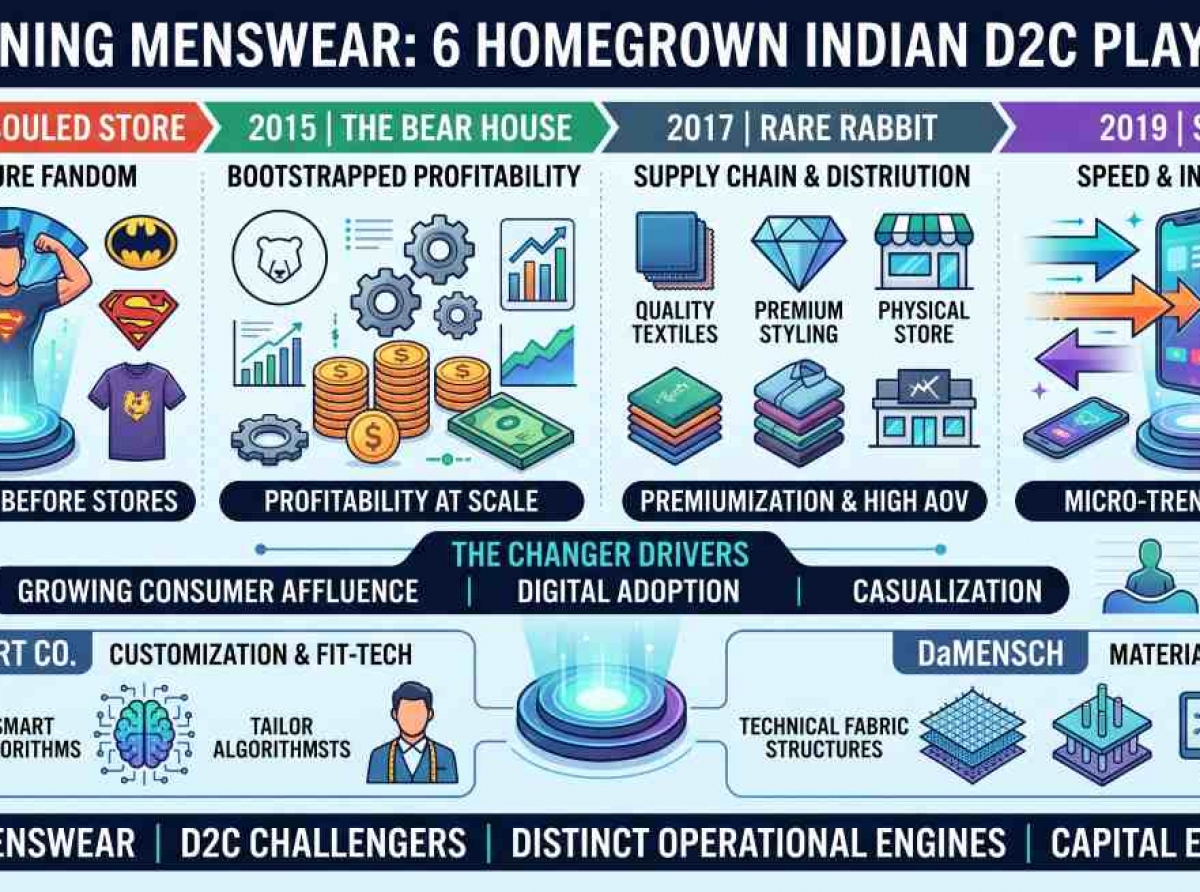
India’s menswear market, valued at $21.91 billion in 2025 and projected to cross $42 billion by 2034, is changing fast. Once dominated by established denim, formalwear and apparel conglomerates, is now being challenged by founder-led, digital-native brands. The change is not simply about online-first retail. Brands such as The Souled Store, The Bear House, Rare Rabbit and Snitch have built scale using different commercial models, from pop-culture licensing and premiumisation to inventory velocity and lean capital deployment.
Their emergence also signals a broader change in Indian fashion retail: brands no longer need to replicate the traditional playbook of national advertising, wholesale distribution and hundreds of stores to build consumer recognition.
Different routes to scale
The new generation of menswear companies is differentiated by the operations behind their growth.
Table: Six distinct patterns that disrupted modern menswear
|
Brand |
Launch year |
Strategic focus |
Primary distribution mix |
Financial benchmark |
|
The Souled Store |
2013 |
Pop-Culture Licensing & Fan Community |
60% Online / 40% Exclusive Stores |
Rs 492 cr FY25 Revenue; 37% YoY Growth |
|
The Bear House |
2015 |
Bootstrapped Profitability & Lean Inventory |
70% E-Commerce / 30% Marketplaces |
Contribution Margin Positive from Inception |
|
Rare Rabbit |
2017 |
Premiumization, Supply Control & High AOV |
55% Physical Retail / 45% Online |
Rs 637 cr FY24 Revenue; Rs 75 cr Net Profit |
|
Snitch |
2019 |
Speed-to-Market & Micro-Trend Velocity |
60% Online / 40% Physical Stores |
Rs 900 Cr FY26 Revenue; 115 Exclusive Outlets |
|
Bombay Shirt Co. |
2012 |
Mass Customization & Predictive Fit-Tech |
50% Custom Experience Stores / 50% Web |
Bespoke On-Demand Production (Zero Deadstock) |
|
DaMENSCH |
2018 |
Material Innovation & Technical Apparel |
65% Online / 35% Multi-Brand & Outlets |
Capital-Efficient Scale across Innerwear & Loungewear |
The Souled Store exemplifies how intellectual property can substitute for conventional brand-building. By securing entertainment, sports and comic licences, it transformed fan affinity into repeat purchases before investing heavily in physical retail. Its Rs 492-crore FY25 revenue demonstrates the commercial potential of building a community around cultural identities rather than generic fashion.
Rare Rabbit took almost the opposite route. Their strategy emphasised manufacturing control, premium fabrics, retail presentation and higher average order values. The result was Rs 637 crore in FY24 revenue and Rs 75 crore in net profit, highlighting how premiumisation can deliver stronger economics than pure volume-led growth.
The Bear House model is: capital discipline. Its relatively lean inventory structure and emphasis on positive unit economics demonstrate that rapid expansion does not necessarily require aggressive cash consumption.
Speed becomes the anchor
Snitch represents perhaps the clearest expression of India's fast-fashion opportunity in menswear. The brand has built its proposition around rapid product refreshes, reportedly introducing as many as a dozen styles a day to capture micro-trends.
Its evolution from an online-first retailer to an omnichannel network of 115 exclusive outlets reflects another important shift. Physical stores are being used not only as brand showcases but also as fulfilment and customer-acquisition assets. With offline revenue accounting for about 40 per cent of its mix, Snitch has expanded beyond metros into Tier II, III markets. Quick-commerce pilots offering apparel delivery within 60 minutes in cities such as Bengaluru and Delhi further illustrate how speed is becoming part of the product proposition.
The model helped them reach Rs 900 crore in FY26 revenue with positive EBITDA, showing how inventory velocity can become a competitive advantage when supported by data-led demand forecasting.
Selling less, but smarter
Other challengers are attacking a different weakness in conventional apparel: inventory risk. Bombay Shirt Company uses fit technology and made-to-order production to manufacture garments after customers place orders. Its model reduces exposure to unsold inventory and end-of-season markdowns, a persistent problem in fashion retail.
DaMENSCH has built differentiation around the product itself. Instead of relying exclusively on advertising or discounts, it invested in proprietary yarn and fabric development, including technical and bamboo-based materials. Such differentiation allows the brand to command a premium while building repeat purchase behaviour. These models show that the next phase of Indian menswear may be defined less by assortment size and more by the efficiency of the underlying commercial engine.
The omnichannel test
The shift from digital discovery to physical retail, however, comes with new risks. Rising high-street and mall rentals can quickly erode margins if stores fail to generate sufficient sales density. In smaller cities, Cash-on-Delivery returns and reverse logistics can similarly weaken online economics. Fast-fashion businesses face an additional challenge. Introducing hundreds of new products every week creates substantial exposure to demand forecasting errors. A trend that fails to resonate can rapidly turn into obsolete inventory.
Premium brands face the opposite problem: specialised fabrics and longer sourcing cycles can constrain responsiveness and tie up working capital. The winners are therefore likely to be those that balance online reach with selective physical expansion, while using localised logistics, tighter supplier management and demand analytics to control inventory.
A new retail perspective
The rise of homegrown menswear challengers points to a larger transformation in Indian fashion. Their competitive advantage is not simply that they are younger than legacy brands. It is that they have been designed around new consumer behaviours from the outset. Some monetise fandom, others speed, customisation, premiumisation or fabric innovation. Yet all are demonstrating that scale can emerge from sharply focused propositions rather than one-size-fits-all expansion.
As India’s D2C market moves toward the $30-35 billion GMV range, the competitive question for legacy menswear players is no longer whether these challengers can build brands. It is whether traditional businesses can adapt their slower product cycles, distribution structures and inventory systems quickly enough to compete with them.










 Get in Touch!
